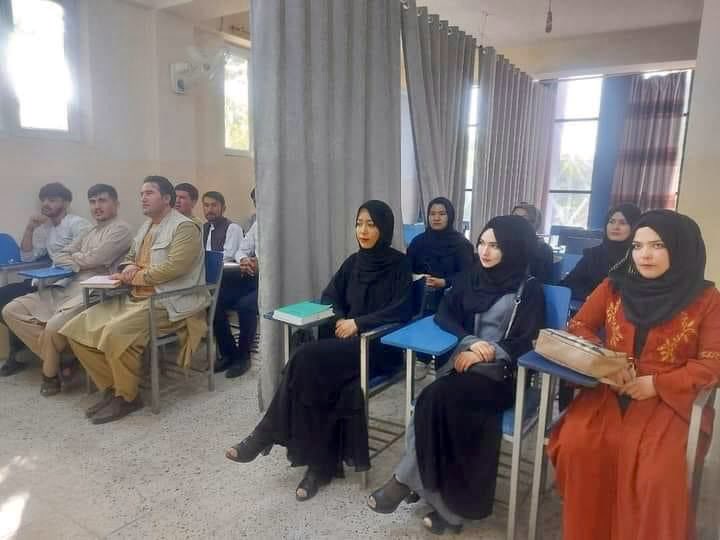
They’ve gone dark: Afghans who helped the U.S. military, trained as American-style journalists and rode the wave of women heading to higher education are destroying the diplomas, transcripts and résumés that prove how they built civil society in the country that the U.S. has left behind.

OPINION: Twitter terror ban a start, but youth need education to combat ISIS message
By Megumi Sano
GSS Correspondent
PARIS — Currently, the Islamic State of Iraq and the Levant, or the so-called ISIS, is expanding its territory across Syria and Iraq. ISIS is a jihadist extremist militant group and has been recruiting thousands of people across the globe. Unfortunately, its international recruitment has been successful with its effective use of online propaganda, thus maximizing its power as an international terrorist organization.
Two weeks ago, Twitter announced that it has suspended more than 125,000 accounts “since the middle of 2015 alone” for “threatening or promoting terrorist acts, primarily related to ISIS.”
“Like most people around the world, we are horrified by the atrocities perpetrated by extremist groups,” the company said in a statement. “We condemn the use of Twitter to promote terrorism and the Twitter Rules make it clear that this type of behavior, or any violent threat, is not permitted on our service.”
Twitter to ISIS: delete your account. https://t.co/fLW9SEzORo pic.twitter.com/N89T5ostIe
— New York Magazine (@NYMag) February 6, 2016
Unfortunately, it may take more than Twitter to suspend ISIS’ recruitment efforts among youth.
As early as 2007, Jonathan Evans, the United Kingdom’s MI5 Chief, reported that “(t)errorists were methodically and intentionally targeting young people and children in the U.K.”
Leila Zerrougui, the UN Secretary-General’s Special Representative for Children and Armed Conflict, reported in 2014 that ISIS “has tasked boys as young as 13 to carry weapons, guard strategic locations or arrest civilians.” Last March, The Guardian reported that ISIS “has used children as human shields, suicide bombers, snipers and blood donors.”
Not only is the recruitment of young people crucial to the terrorist group’s continual existence in the future, it is also beneficial to the recruited victims because the group offers to meet their personal, economic, and social needs.

Leaders around the world have started to address this issue. U.S. President Barack Obama told participants at a White House summit last February on countering violent extremism that “we are focused on prevention, preventing these groups from radicalizing, recruiting or inspiring others to violence in the first place.”
However, our focus must be on the recruited, rather than the recruiters. How can we prevent people from embracing hateful ideologies before they turn to violence?
The most prominent form of prevention is proper education.
With the right resources for the younger population, we can prevent the growth of these terrorist organizations in the long term. Many who enroll in these organizations are motivated by the impulsive desire to escape their own situations. Often they don’t know about the harsh realities of these groups. By bolstering local educational resources, we can provide them with the right knowledge.
For instance, the United States and the United Arab Emirates are planning to launch a digital communication hub along with technology camps, to further push back against the cyber recruitment efforts. Furthermore, school-based programs with names such as “Getting On Together” and “Challenging Extremism” are raising awareness among students and teachers about radicalization.
Especially in developing countries, poverty can push people to make irreversible choices. High jobless rates take away their economic prospects, leaving them to feel that they have no alternative option. Enrollment in ISIS requires only a recommendation by a previous member, making it easy for one to join. If people are granted financially more stable lives and more job opportunities, the less likely they are to turn to ISIS or any other terrorist organization.
On the other hand, in developed countries, we must end prejudice towards the minorities. Terrorists radicalize immigrant populations, youth, and alienated minorities by manipulating and exploiting their grievances. Muslims in developed countries often feel excluded from society, developing their ambition to live in a place where they feel accepted. This place tends to be a terrorist group, for the recruited members hold diversity despite their uniformity.
We must address the political and economic grievances disaffected youths may have to make them feel welcomed in their own society.
A combination of these measures has the potential to prevent international terrorist recruitment. It can also alleviate the ongoing Syrian refugee crisis in Europe, by quelling the growth of ISIS.
The number of these refugees, shoved out of their own country by ISIS, has now reached an astonishing 4 million. But little by little, we can make a difference.
—Featured photo: Silhouettes of people checking mobile devices while standing against an illuminated wall bearing Twitter Inc.’s logo, in London on Jan. 5, 2016. Twitter may be preparing to raise its character limit for tweets to the thousands from the current 140, a person with knowledge of the matter said. Photographer: Chris Ratcliffe/Bloomberg via Getty Images, used with permission via Camayak.
 Megumi Sano is a student at Southbank International School in London. Opinion columns published on GSS represent the views of the author only and not Global Student Square. Contact Sano at megumi.sano@southbank.net.

Related Posts