They’ve gone dark: Afghans who helped the U.S. military, trained as American-style journalists and rode the wave of women heading to higher education are destroying the diplomas, transcripts and résumés that prove how they built civil society in the country that the U.S. has left behind.
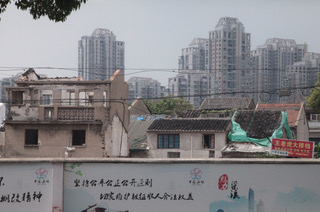
A glimpse over the wall: Living in the last urban village in Wuxi, China
By Beiyin Zhang, Chengjie Gu, Jinghan Wang, Shi Zhang, Xunyu Hua, Yimeng Tang, and Yining Zha
Jiangsu Tianyi High School
Special to Global Student Square
WUXI, China — Surrounded by concrete barriers and dense bushes, a ramshackle pile of buildings is the remnant of the last urban village in Wuxi, a city located approximately 145 kilometers northwest of Shanghai.
Ironically, the name of this village — Jia Cheng Li, which literally means “caught up in the city” — turned out to be a prophecy.
This time-honored neighborhood where Wuxi’s oldest residents live is now located in one of the fastest-growing regions of Wuxi, bordering the local central business district. Center 66 — a towering glass skyscraper housing a shopping mall and office towers, plus a Nikko Hotel — are all less than one kilometer away.
But to the passerby, Jia Cheng Li seems invisible. The wall blocks out curious eyes as well as economic development. Unlike the business district, Jia Cheng Li suffers from poor sanitation and crime at night, lacking any security or network surveillance.
Since 2009, the Chinese government has been expropriating property in Jia Cheng Li, offering compensation and the promise of a more modern city. Elderly residents, some in their 90s, have preserved their daily routines in the ruins. Despite the push to modernize, they have tried to keep the old ways of life.
“Houses were built in the last century with the savings of our fathers, some of whom first arrived here by boat, carrying nothing but family,” said resident Wang Sheng, a tall skinny man in his 40s.
“We support the leadership of (the Chinese Communist Party) and the city development,” said Xu Jingfang, Lee’s neighbor. “But this conflict is indeed too hard to deal with.”
‘Fewer shanties, better city’
The Chinese government officially put the renovation of shanty towns such as Wuxi’s Jia Cheng Li on its agenda in 2009, a year before the Shanghai World Expo. The expo’s slogan – “better city, better life” – became popular, echoing support for urbanization.
This idea was further interpreted as a guideline by the government and most of the urban dwellers: “Fewer shanties, better city.” From 2013 to 2018, more than 26 million households were seized in the name of urban development nationwide, leading to the removal of more than 100 million residents.
Premier Li Keqiang more than once expressed his concern over this renovation, saying that “(s)hanty towns are debts of history and scars of cities.”
“To renovate means more than to rebuild,” he later added. “(It is) also to create a new life.”
According to the Wuxi Urban Planning Bureau, the first phase of the plan, which began in 2009, was to demolish dilapidated buildings.
But change was not easy. In the absence of any national policy governing compensation for seized land, the expropriation of Wuxi residents’ property fell under the guidelines set by Jiangsu Province, which ordered that “land value shall be decided by the evaluation of the market.”
Residents and real estate agents disagreed on the potential market value of the land at stake. Negotiations ensued, leading to a 10-year stalemate between 337 families and the Chinese government.
In 2013, the Wuxi Urban Planning Bureau established a new design named “Wuxi Manhattan.” Eventually, the central business district would function as a trade center with cultural hubs by the canal.
New residential units were built, but at prices which residents couldn’t afford; over the past few years, housing prices have risen faster than the compensation residents have received. According to data from Anjuke, an online real estate platform, since 2012 the average housing price in Jia Cheng Li has risen from around 8,000 yuan per square meter to more than 14,100 yuan per square meter, while the compensation for buildings has increased only from 7,000 yuan per square meter to 11,500 yuan per square meter.
The plan seems to be working: So far, plazas and office buildings have risen and flourished outside Jia Cheng Li.
Yet within the walls, the pace of life remains still.
“This part of land belongs to me. If more people come to live, we could simply build up another floor, like we did. There’s no way to afford apartments for so many people with the compensation,” said Lee Qingmin, whose mother is in her 90s and has lived in Jia Cheng Li for more than 60 years.
He described himself as part of the lowest class of society. “Those who are affluent … left, leaving only the poor and the elderly,” he said.
Now that change is underway, whenever a moving truck leaves, a demolition team comes. Ten years of destruction have painted this land with ruins, ashes and half-intact buildings.
“Sometimes thieves would hide in (a pile of garbage) during the day,” an unidentified woman said. “In the evening they knock on our doors to check whether there are people inside, and if not, they break in.”
A space to share stories
Despite such problems, ties to the neighborhood remain strong.
Ten years ago, Huang Shumin was among the first wave of residents to leave Jia Cheng Li. It was once her dormitory when she worked at a textile mill. It was said that in the 1970s, Jia Cheng Li was considered the silk-stocking district of the city; a girl would be blessed to marry someone there.
Today Shumin’s grandchild is in kindergarten, receiving advanced English training, and her family has decided to let her study abroad. Shumin said that she still felt a connection to this neighborhood.
As is true of many old neighborhoods, most of those living in Wuxi maintain close relationships with other members of the community. After dinner, they each bring a chair to the main road next to their houses, leaving just enough space for a car to pass.
In the borrowed light from their homes, residents create a casual public space in a dialect that only the locals understand; none of the seniors speaks Mandarin.
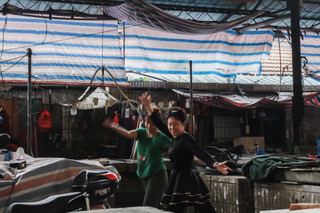
A hundred meters away is the food market of Jia Cheng Li, a place, though shabby and messy, that is bustling with life. There are fabrics with different patterns and blue iron plates. Shops on the left side of the street sell meat and those on the right sell chickens, ducks and fish, while other shops scattered in the center of the narrow walkways sell vegetables.
“The best value of the local food market is convenience. It’s easy for the people who live around here to buy food, ” a shopkeeper says, trimming a layer of fat off on a piece of pork. “We never weigh wrongly; (we are) always fair and reasonable.”
He pointed to a banner above a little room that said, “Customers should shop the local market and their rights should be protected.”
All the established sellers have worked here for more than a decade, allowing them to build connections with the buyers. Thus, a community was formed. Every lunchtime, the “aunties” of the market turn on a boom box and dance to Chinese pop music.
A major announcement — and an inevitable change
Unfortunately, the market will likely disappear.
In May 2018, the government decided to push forward with demolition. An abandoned building was turned into an expropriation office where lawyers argued over issues. Red banners with yellow characters were strung throughout the yard of the office as well as the whole Jia Cheng Li neighborhood. One slogan depicted the project as “breeze of spring,” which would bring “warmth and vitality” to the community as if the demolition team was given the power to destroy and rebuild.
In the office, a form began to track the progress of expropriation, listing all the proprietors of the 337 “nail houses,” many of whom have been labeled “dead.” They were the ones who were the founders and first residents of the community, and they are the ones who became stories told by their children.
Then in June 2018 came a major announcement: The expropriation office ordered the remaining dwellers of Jia Cheng Li to move out within six months, warning that it would take legal steps if residents refused.
Thus the full reconstruction of Jia Cheng Li seems inevitable. Another 35 acres of land will join the city development, and original inhabitants scattered.
“Some of the superstitious elders believed that feet leaving home represents death,” said Lee Qingmin. “Even an extra pension and a better environment wouldn’t persuade them.”
“Most of my neighbors have moved away,” his mother added. “I haven’t because I could not afford it. If I were to move, it’s likely that I would not know any of my new neighbors.”
—This story was reported and written by students participating in JEA China‘s 2018 Youth Observation Contest, where it received a superior rating. It has been edited for publication by Global Student Square and is published with permission.

Related Posts