They’ve gone dark: Afghans who helped the U.S. military, trained as American-style journalists and rode the wave of women heading to higher education are destroying the diplomas, transcripts and résumés that prove how they built civil society in the country that the U.S. has left behind.

OPINION: California teens deserve a healthy approach to sex ed
By Natalie Venable
Newsroom by the Bay Now
THOUSAND OAKS, Calif. — Eight months into the COVID-19 pandemic, it can be hard to imagine a school board meeting including discussion of anything other than the daunting task of how schools can safely offer in-person classes.
Yet in a southern California school district, the school year kicked off last fall with a rancorous debate at a Aug. 20 meeting of the Conejo Valley Unified School District Board of Education over a new sexual education curriculum, including public comments by parents who were outraged at the possibility that their kids would soon be taught about pornography and sex toys in health class.
Three months later, mention of Assembly Bill 329, the law that sparked this controversy, makes school board trustees, teachers and parents alike shudder.
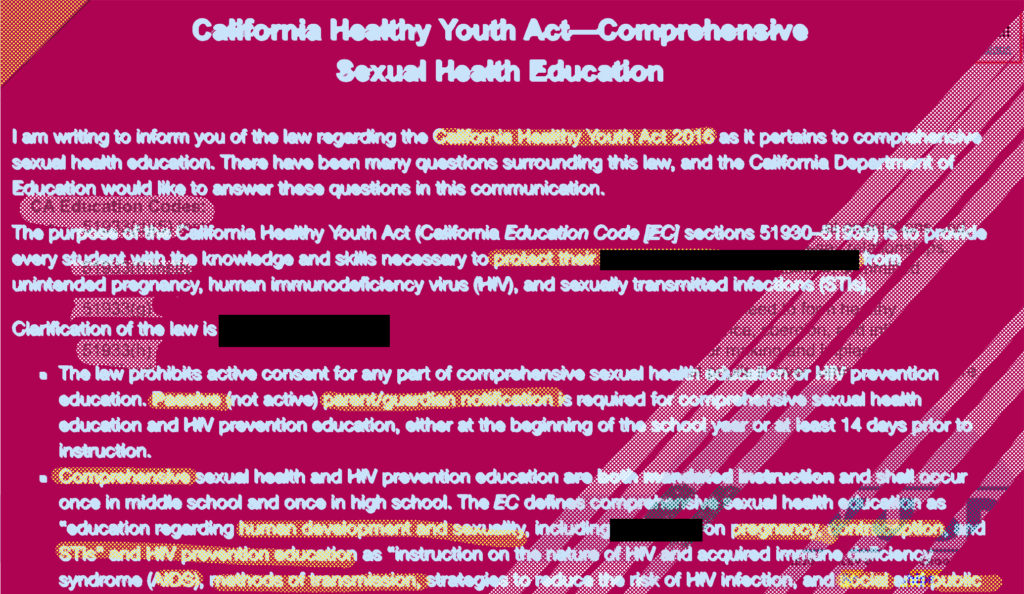
In 2016, California passed the California Healthy Youth Act. The law’s goals were to require comprehensive sex education with an emphasis on HIV prevention and to encourage healthy attitudes, behaviors and relationships. It strengthened requirements for inclusivity in sex education, ensuring that the curriculum acknowledges all gender identities and sexual orientations. The law requires students to undergo comprehensive sex education twice, once in seventh grade and once in ninth grade. The average ninth-grader is 14 to 15 years old, but the average American first has sexual intercourse around age 17.
“Too much of the recommended material focuses on children’s sexual pleasure, anal sex, oral sex, changing gender norms, teaching children how to consent to sex and teaching children how to get an abortion and birth control during school hours without parental consent,” said former Board Trustee Sandee Everett, as quoted by the VC Star in an Oct. 10, 2019 story about the “Tuesday night fights” about sex ed and other issues at school board meetings.
Resistance to the Healthy Youth Act appears to be misguided and based on rumor. Some parents fears that the curriculum promoted the use of sex toys and directed students to inappropriate websites. However, both of these claims are false.
Unfortunately, districts instead are folding under outcry and delaying implementation. Districts tend to cite waiting for a framework from the California State Board of Education — which was approved on May 8, 2019 — as cause for the delay, but the framework is simply recommendations, not mandates. Even worse, the law includes no additional funding for implementation or enforcement, enabling the delays.
“There’s been some resistance to moving forward, not just in the area of health but across-the-board in terms of making sure that our curriculum is the most up-to-date, scientifically accurate, and inclusive,” said Lauren Gill, who was elected to the CVUSD Board of Education in November and will begin her term on Dec. 15. “That has to do with the fact that the previous board majority kind of slow-walked anything that they felt was controversial. And certainly the Healthy Youth Act fits into that category.”
The CVUSD is in the process of proposing a curriculum for ninth grade. Their plan is to supplement the Glencoe Health curriculum, from 2005, in order to be compliant.
The proposed curriculum is, simply put, pathetic. While it includes updated material on birth control and gender expression, identity, and sexual orientation, it leans on blame-shifting, scare tactics and out-of-context visuals that are commonly associated with abstinence-only approaches.
For example, the proposed curriculum includes just one slide about consent — surely a topic that bears more discussion in our “Me Too” times — and one slide about “being assertive” in refusing sex. One of the proposed homework assignments for students includes a question in which students are asked to list ways one can handle a situation in which they are being pressured into sex. Just like teaching young women to cover their drinks and carry their keys between their fingers, this assignment puts emphasis on the victim’s actions. Instead, we should be teaching young people to not be the perpetrator in these situations
It’s 2020. Why are we still pretending that “Just Say No” works?
The CDC’s Rape Prevention and Education’s “technical package” — defined as “a select group of strategies based on the best available evidence” to stop sexual violence — promotes empowering young women, but it also promotes mobilizing young men as allies and dismantling the “bystander” culture that enables and normalizes rape. The package also emphasizes the importance of comprehensive sex education that promotes healthy communication and consent in reducing sexual violence.
This is the sort of education the Healthy Youth Act should be inspiring. Instead, CVUSD’s proposed curriculum does start with a discussion of healthy relationships, but the old fear-mongering tactics still loom.
For example, slide 61 in a presentation titled Health Education-Grade 9 Supplemental Lessons includes a sexual exposure chart. According to this chart — assuming every person has had the same number of partners — if someone has four sexual partners, they are exposed to 15 people. While this may be technically true, it looks extremely similar to this exposure chart, found on chastity.com and originally created by Why kNOw Abstinence Education program. One in 10 children are victims of sexual abuse. How are they supposed to feel when they look at this chart in health class? We know enough now to be conscious of students that could be victims of unwanted sexual contact.
Also problematic are the slides that directly follow this chart. In comparison to the singular slide on consent, there are 29 slides about sexually transmitted diseases. The curriculum encourages a “talk, test and treat” approach for STDs, but these pictures present them as a shameful consequence of sexual activity. The CDC recommends discussing STDs openly in order to prevent them. Shaming someone with chlamydia doesn’t help.
While the legislative text of AB-329 is a helpful start to improving sex education, with no funding for enforcement or implementation, the law is not holding school districts accountable. As a result, districts are at risk of falling back on old tactics and techniques to scare students into certain behaviors, rather than inspiring healthy and holistic change.
Conejo Valley Unified School District, which is ranked #156 out of all 1,013 school districts in California, should be a leader in this area. It should be setting an example, not cowering in fear of controversy.
Students can speak at school board meetings, join local groups that offer examples of effective ways to promote healthy sexual attitudes for inclusive education, and view their district’s curriculum online. It’s up to us as students and community members to hold them accountable and advocate for change.

Related Posts