They’ve gone dark: Afghans who helped the U.S. military, trained as American-style journalists and rode the wave of women heading to higher education are destroying the diplomas, transcripts and résumés that prove how they built civil society in the country that the U.S. has left behind.
Supreme Court’s newest justice follows in the seat but not the footsteps of Ruth Bader Ginsburg
By Grace Sandman
Newsroom by the Bay Now
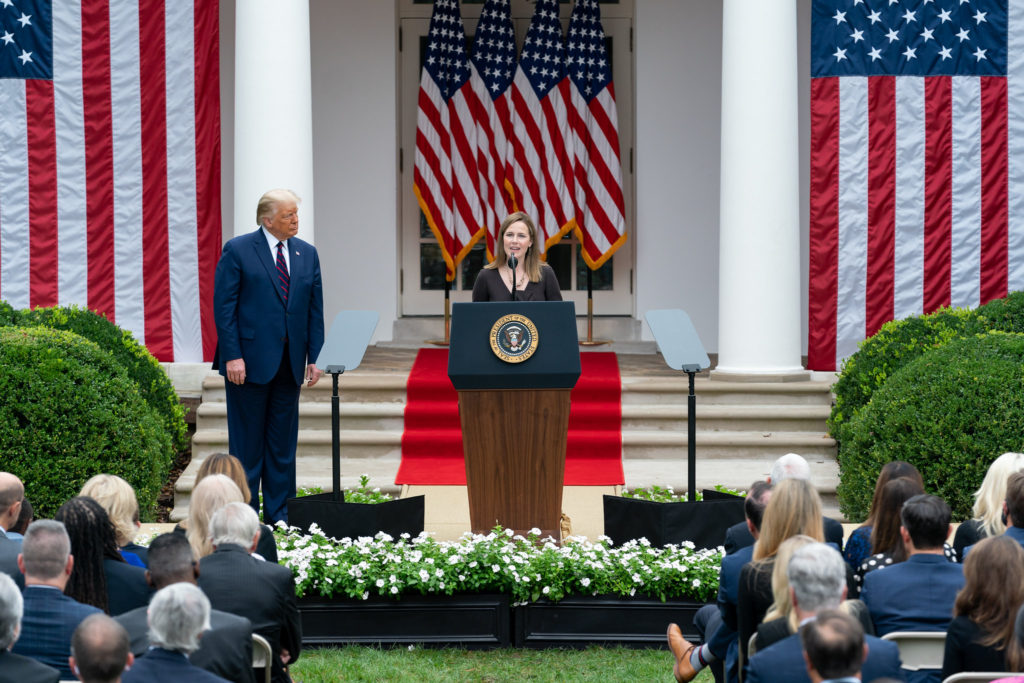
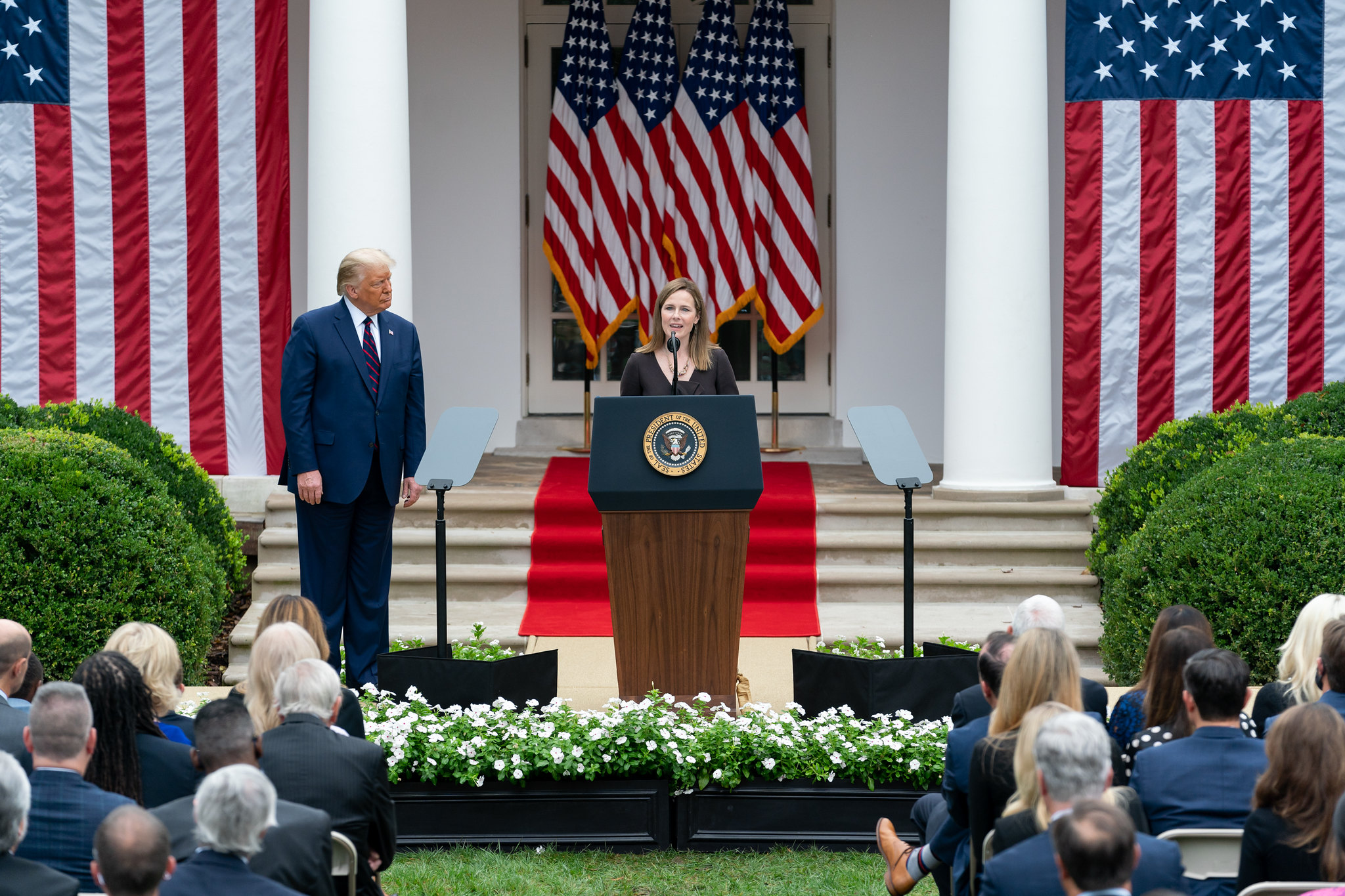
PASADENA, California — The newest addition to the Supreme Court has taken the seat of a judge whose last words urged a different outcome.
“My most fervent wish is that I will not be replaced until a new president is installed,” Supreme Court Justice Ruth Bader Ginsburg said just before she died of pancreatic cancer on Sept. 18, just 46 days before the 2020 presidential election.
Despite Ginsburg’s wishes, hours after her death Senate Majority Leader Mitch McConnell promised to put forward President Trump’s nominee. Critics pointed out that this directly contradicted his actions to block President Barack Obama from filling a vacant seat during his final year as president.
Nevertheless, after an historically rapid confirmation process that took just over five weeks, on Oct. 26 the Senate approved Barrett’s nomination by a vote of 52-48, making her the fifth woman appointed to the Supreme Court and the first by a Republican president since Sandra Day O’Connor in 1981.
Who Barrett is, what she represents and how she will shape the court going forward is a question that will endure well into 2021.
Precedent rocked — and a nod to the past
From the start, mentions of Barrett invoked the past — not only Ginsburg, but her personal friend and conservative opponent, Supreme Court Justice Antonin Scalia.
Scalia died in 2016 at age 79. Revered as one of the most influential conservative justices in history, Scalia was known as a strong opponent of abortion and affirmative action, and an advocate of federalism and separation of powers.
Barrett, 48, clerked for Scalia, sharing his originalist views — the belief that judges should try to interpret the Constitution’s words based on their understanding at the time they were written.
Despite Ginsburg’s friendship with Scalia, his former clerk stands on the other side of a political divide from Ginsburg, whose cultural and legal legacy as the court’s liberal voice could not be further from Barrett’s beliefs as expressed in her writings and public statements prior to her confirmation.
Former Senate Judiciary Committee counsel Mike Davis expressed his approval; his Article III Project advocated for her and other conservative nominees.
“For the first time in more than 80 years, we will have a true conservative majority on the Supreme Court,” he said. “This means that the Supreme Court will protect everyday Americans from government overreach and mob rule.”
Vice President-Elect Kamala Harris disagreed. “By replacing (Ginsburg) with someone who will undo her legacy, President Trump is attempting to roll back Americans’ rights for decades to come,” she said during Barrett’s first confirmation hearing on Oct. 12.
The new justice will shift the conservative to liberal balance to 6-3 from 5-4 and will likely have an immense impact on future cases.
On Nov. 4, the day after the presidential election, Barrett heard Fulton v. City of Philadelphia, a case in which the justices will consider if Philadelphia violated the 1st Amendment by refusing to contract with Catholic Social Services, which refused to provide services to same-sex foster parents. The case has major implications for the LGBTQ community.
Barrett also participated in a Nov. 10 hearing on the Affordable Care Act. In a 2017 essay she criticized it and Chief Justice John Roberts, saying that in a 2012 case called NFIB v. Sebelius, “Roberts pushed the Affordable Care Act beyond its plausible meaning to save the (ACA).”
If lawsuits challenging state election procedures are appealed to the Supreme Court, Barrett could be the one who shifts the balance and helps decide who becomes president and who controls Congress next January.
The political is personal
A mother of seven as well as a jurist, Barrett would seem to be a feminist model.
Barrett is a former law professor at Notre Dame University and judge on the Chicago-based 7th U.S. Circuit Court of Appeals. She has a conservative voting record in cases touching on abortion, gun rights, discrimination and immigration.
Barrett has come under fire for her views on the Constitution, her membership in a conservative Christian faith group and her statements on the ACA and abortion. Though like other confirmation candidates Barrett refused to discuss upcoming cases, some court observers and organizations fear that she would put at risk the right to abortion established in Roe v. Wade and marriage equality in Obergefell v. Hodges. In particular, the LBGTQ community fears a rollback of the Supreme Court’s 2015 ruling making same-sex marriage legal.
“The court could significantly water down what marriage means for LGBTQ couples across the nation to what the late, great Justice Ginsburg, called ‘skim milk marriage,'” Human Rights Campaign President Alphonso David said in response to justices Clarence Thomas and Samuel Alito’s recent attacks on Obergefell v. Hodges.
Gen Z fears for the future
Barrett’s presence on the court has some young Americans concerned.
According to the NAACP Legal Defense and Educational Fund, Inc., Barrett has spoken before the Alliance Defending Freedom, an American conservative Christian nonprofit organization that has been designated a hate group by the Southern Poverty Law Center due to its extreme anti-LGBTQ views. Alliance Defending Freedom is also known for its advocacy for the re-criminalization of homosexuality.
Gen Z citizens and future voters worry that those ties could block their own choices.
“Amy Coney Barrett directly threatens me as both a woman and a gay woman because she’s very pro-life, which means that she would like to limit my access to my body,” said Dri Defaria, the co-founder of Chats 4 Change, a group that hosts weekly discussions about current events and activism in the digital age.
“Through multiple choices she’s made in the past it is very clear to me that she does not respect people of my origin, my gender, or my sexuality,” said Defaria.
“I fear that in the future I may not be able to hold hands with who I please and feel safe if there are steps to reverse the previous strides for equality,” said Drew Valentino, a junior at Mayfield Senior School in Pasadena, California. “We should be moving forward, not backward.”
“I pray for a future of safety but it seems bleak at this moment as a woman (and a) part of the LGBTQ community,” Valentino said.
Concerns that Barrett will shift the court’s balance to the right are fueled by Trump’s public statements regarding the reasoning behind his Supreme Court picks. During a presidential debate in 2016, Trump vowed to appoint justices who’d vote to overturn the 1973 Roe v. Wade decision that legalized abortion nationwide.
But they are also backed by Barrett’s own actions. In 2016, Barrett was a member of the University Faculty for Life at Notre Dame. Online records show that the group began promoting South Bend’s Women’s Care Center on its website in 2016, adding a link to the group under a section called “Pro-Life Links.” The center is a clinic that advocates worry may mislead vulnerable women who were seeking abortions and pressure them to keep their pregnancies. She has also signed ads that promote the abolition of abortions.
Based on those actions, pro-choice activists are worried that Barrett is a threat to women’s reproductive rights.
“I think her beliefs about abortion are incredibly dangerous, because legally ruling out a practice or operation in this case will never fully eradicate those who will need it or the business itself. It would realistically create harm to many, whether it be physically, monetarily, or emotionally,” said Mayfield Senior School freshman Lily Salazar.
“It also sets back the given fact that women should be given a choice; regardless of beliefs. Having personal boundaries and beliefs should be respected, but we should also respect and understand the circumstances that would warrant a woman in need of an abortion,” Salazar said.
Yet others are willing to watch and wait — or even change their minds.
Kate Thompson, a junior at Mayfield Senior School found herself struggling to grapple with understanding information presented to her about Barrett via Instagram versus mainstream news outlets. After doing more research, she discovered that Barrett shared many of her own beliefs.
“On Monday night a Catholic mother of seven was sworn in by an African American who is a descendant of slaves. Putting politics aside, that is an amazing and honorable picture when neither (had) the right to vote just 100 years ago,” Thompson said.
“Today, abortion laws have gone too far,” Thompson added. “‘Safe, legal, and rare’ has turned into ‘unsanitary, legal, and celebrated.’ ”
Elevated — for life
On Monday, Oct. 26, the Senate voted mostly along party lines 52-48 to confirm Barrett. It was the first time since 1869 that a Supreme Court nominee has been confirmed without a single vote from a major minority party. Only one Republican, Senator Susan Collins (R-Maine), voted against Barrett after expressing concerns that the vote was coming too close to the presidential election.
But Kentucky Republican McConnell defended his party’s decision. “Elections have consequences,” he said, referring to Trump’s victory in 2016.
A day after the vote, Trump said that Barrett would “make an outstanding justice on the highest court” and noted that she would be the first mother of school-age children to serve on the Supreme Court.
“I am grateful for the confidence you have expressed in me, and I pledge to you and to the American people that I will discharge my duties to the very best of my ability,” Barrett said.

Related Posts