They’ve gone dark: Afghans who helped the U.S. military, trained as American-style journalists and rode the wave of women heading to higher education are destroying the diplomas, transcripts and résumés that prove how they built civil society in the country that the U.S. has left behind.
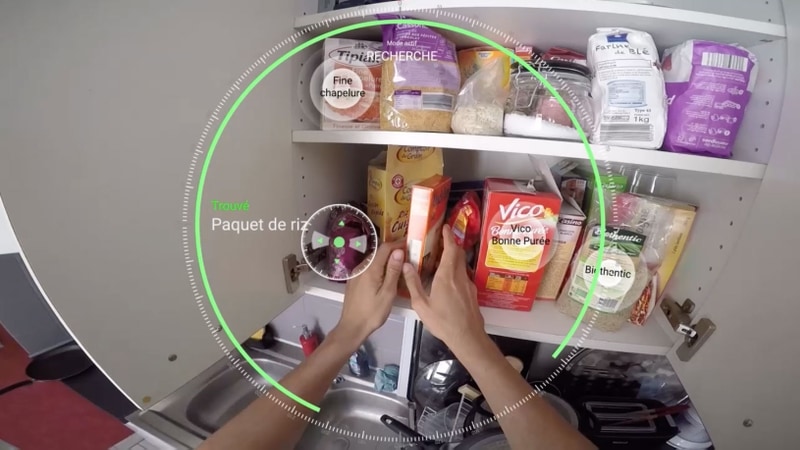
Seeing into the future: PANDA’s augmented reality headset focuses on the visually impaired
By Patsy Fetzer and Melanie Hassoun
American School of Paris
PARIS — Technology is advancing quickly before our eyes — including new products for those who are visually impaired. For the makers of the PANDA virtual reality headset, vision is not only the pitch — it’s the product.
According to the World Health Organization, an estimated 19 million children worldwide are visually impaired. Over the past 25 years, there has been great progress in curing as well as preventing visual impairment all over the world. PANDA addresses another goal, of making everyday tasks and activities easier for the blind.
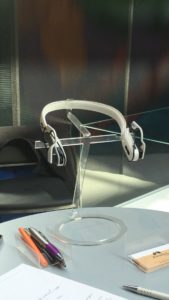
The PANDA headset, which makers call “the 1st reality-augmented auditory audio headset,” is equipped with a micro-camera that films the environment surrounding the person wearing it and use artificial intelligence to “augment” what the wearer sees. Audio also allows the person to understand more about her surroundings.
PANDA uses sensors to identify more than 1,000 different everyday objects. A working prototype of the PANDA was shown at the recent ChangeNOW summit on Sept. 30 at Station F in Paris.
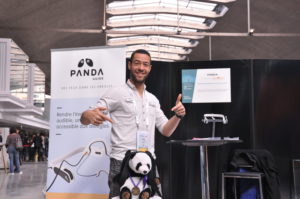
In an interview at ChangeNOW, Arnaud Lenglet, PANDA’s chief executive officer, revealed that he has a personal reason for what he’s developing.
“A good friend of mine is blind,” he said. “And last summer she had an accident. She fell onto the tracks between the train and the station. Fortunately she was not deeply hurt, just a scratch on the leg.”
Lenglet, who had been working in the tech field for four years, asked himself why was he working on robots when he could take what he knows and apply it to human beings. PANDA is taking pre-orders for its headset, which is scheduled to come out in September 2018 at a price of 1,200 euros (US $1,410.90).
Promising as it seems, PANDA isn’t the first tech attempt to develop resources for the visually impaired.
The app “Be My Eyes” allows users to sign up as either a “seeing” person or a “non-seeing” person. Those who are “seeing” receive video chat calls from those who are visually impaired so that they can help with simple tasks, such as picking out a sweater to wear or finding a remote control.
But help with everyday tasks isn’t all.
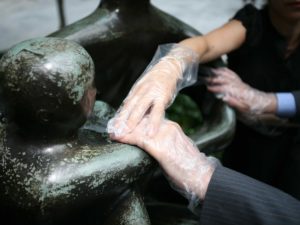
The Museum of Modern Art in New York is home to 200,000 pieces of modern art as well as Touch Tours, which allow blind and partially sighted people to touch sculptures by Picasso, Matisse, and Rodin. Plastic gloves are worn to protect the art, but the texture and temperature can still be felt.
Cooking can be challenging for the blind due to the lack of sensory references. That led to the development of Folks Kitchenware, a line of kitchen appliances created for use by the visually impaired. For example, a Folks teaspoon rises as liquid is poured into a cup, allowing a blind person to sense how quickly the liquid is rising and lowering the risk of burns.
In the classroom, the Livescribe pen allows users to take notes while recording a lecture or alternatively, to press a record button to capture the lesson. Students who cannot look at a screen for long periods of time can find the pen useful.
—Featured photo: Augmented reality allows PANDA users to see into a kitchen cupboard and locate needed ingredients. Photo by PANDA.

Related Posts