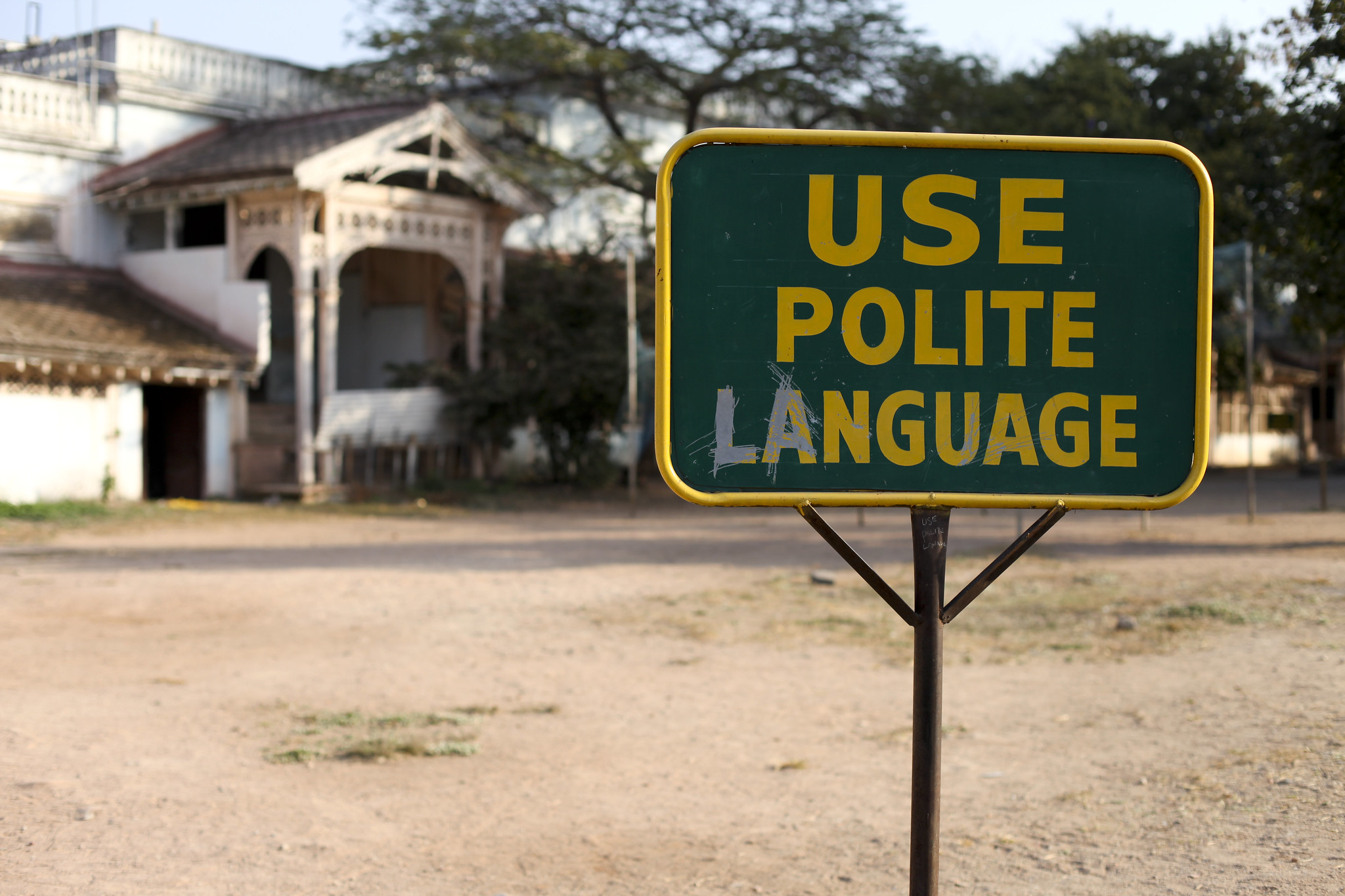
Young journalists often face contradictions when it comes to talking about social and political issues. Curricula emphasize phrases like objectivity and unbiased coverage, but where do you draw the line?
Review: Visual awe, promising characters, smart humor in ‘The Force Awakens’
By Louis Grelot, GSS film critic
PARIS — “The Force Awakens“ has already beat the record for the largest box office opening weekend in the history of the United States. And it’s on its way to compete with “Titanic” and “Avatar” as the largest grossing movie of all time (though it may not break “Avatar’s” global reach).
But just how good is the latest episode of the most iconic franchise of all time?
I will start this review with a small analogy. When I left the theatre upon seeing “The Force Awakens” for the first time, I had fun, but I couldn’t help but feeling extremely disappointed. The film had in a way, not lived up to my expectations. It wasn’t what I wanted it to be.
However, upon seeing this chapter of the “Star Wars” saga a second time, I had accepted it as it is, and was able to appreciate it much more than I had. I realized that there is quite a lot to appreciate in “The Force Awakens.”
From the opening scene, the tone is set with the birth of the First Order, the remnants of the original empire 30 years after its fall. The First Order — led by the menacing Kylo Ren, a Darth Vader-like character (for very precise reasons) — is looking for crucial information in order to find someone. But their actions cause one of their own stormtroopers, Finn, to turn away from the Order.
On the run, Finn encounters Rey, a young but extremely independent woman condemned to live on her desert planet, and with dreams of maybe one day leaving it. However, her life is suddenly changed by the arrival of a small droid, which may just have the information the First Order is looking for, launching her and Finn into an adventure they had not expected, possibly under the guidance of a very familiar face.
If many elements of this exposition sound familiar, then you’re not wrong, because “The Force Awakens” is full of references to the previous films that it cannot escape. These references may just be pushed a bit too far at one point (and more on that below).
So … just how good is “The Force Awakens”?
It’s good — not great, but not too far from great.
Let us start with the good: The direction of the film is by far one the best we’ve seen in blockbusters these last couple years and with one crowning result — the Star Wars universe has never felt so real. The days of the computer-generated sets and characters of the prequel films seem very distant; every creature, set and explosion feels organic.
Director J.J. Abrams shows once again that he is a master at blending real and computer-generated effects, as he did in the recently released “Mad Max Fury Road.” Abrams proves that new and old can be blended to create visual awe.
Speaking of new and old: The cast and characters of the film cannot go unmentioned. We see favorites and legends such as Han Solo and Chewbacca. General Leia‘s return to the screen offers a feast of nostalgia and pulled heartstrings. Harrison Ford reprising Han Solo is by far the highlight of this film, with the energy and wisecracks of the character returning, marked by the maturity brought by 30 years of aging.
The only real weak character in the returning cast is C3P0, whose lines are the most conspicuous of the film, and could even be considered cringe-worthy by the end.
But what of the new generation of Star Wars characters and actors? Abrams must be commended for taking the same risk as “Star Wars” creator George Lucas did in the first film by hiring unknown actors that Lucas transformed into superstars and household names.
The latest team of actors includes Daisy Ridley, John Boyega, Oscar Isaac, and Adam Driver. As might be expected, the result is some hits and some misses.
As “The Force Awakens” begins, Isaac’s X-Wing pilot Poe Dameron is a promising character, likable and adventurous, but suffers from being cruelly underused for the rest of the film. John Boyega’s Finn is an original character, out to distance himself from his origins, but his hyperactive behavior can come off as a bit annoying.
Luckily, we get Adam Driver’s Kilo Ren, whose Darth Vader-like look and demeanor are an integral part of a character who plays a character he is not meant to be, but will do anything to become. This creates an internal conflict that viewers and new fans of the character may not have expected, but will undoubtedly look forward to seeing again.
Best of all is Daisy Ridley’s Rey: The parallel between Rey and Luke Skywalker is clear and the film is obviously aware of it; yet Rey is a well-developed, strong character, expertly portrayed by Ridley, a rookie actress. Rey’s story will undoubtedly rejoin Luke’s, but it’s also perfectly aligned with Joseph Campbell’s “The Hero and a Thousand Faces,” the history of myth that was original inspiration for the entire saga.
The final highlight of “The Force Awakens” is its humor. Smart, organic, and voiced most of the time by the spherical droid BB-8, a new fan favorite, it never falls flat and doesn’t distract the audience from the other more serious themes of the film.
So .. all this means “The Force Awakens” should be a classic addition to the franchise, right? Unfortunately, there are some nitpicks.
The first is the score: Not that the music is bad or flawed, but there is a standard that is expected from this franchise, whose music is not only instantly recognizable through all cultures, but is also the standard to which all film soundtracks are compared. Composer John Williams has made us accustomed to memorable themes; in “Star Wars,” he used the concept of the leitmotiv better than any film afterwards. It was simply a work of genius that, like “Star Wars” itself, transcended time.
In “The Force Awakens,” some of the original themes are cued at strategic points, but that’s it. Other than Rey’s theme, and the orchestration of a TIE fighter escape, there is arguably no other music in the film that will come off as memorable.
The second nitpick is that it appears that two scenes are missing from the film. They may have not been pivotal scenes, but instead necessary scenes in order to build tension and/or emotion. Instead, you are left with two awkward transitions and the feeling that the resolution to two conflicts occurs too easily and abruptly.
The third and final significant nitpick takes place in the third act of the film (consider this mild spoiler territory if you’ve stayed clear of any promotion for the film, or its poster). Here, two parallel raids are being conducted, one on the ground, and the other by air on the First Order’s new Death Star station.
As any “Star Wars” fan knows, an X-Wing versus TIE Fighter WWII dog fight is one of the most thrilling things that has ever been put to screen. Unfortunately, the thrills are only as good as the characters involved in the action, and the tension built around it. But in the case of “The Force Awakens,” the action is secondary to the most central conflict of the film, which is happening on the ground. This leaves for a rather underwhelming climax in the aftermath of the aerial assault.
The finale of “Force” will be the topic of much debate. Will it satisfy your Star Wars craving ? For me, it was quite the opposite; it’s only stronger, but in the best and most frustrating way possible, because “Force” is the beginning of a new trilogy with questions, unresolved conflicts, and a certain character we just haven’t seen enough.
In the end, “The Force Awakens” is fun and thrilling, but it’s too early to judge its significance since it is a franchise starter. In 1977, the first Star Wars film, now known as “A New Hope,” then broke records for the highest-ever grossing film, but it also launched what many believe is the most significant sci-fi franchises of all time and perhaps even one of the most influential cinematic achievements ever.
Whether or not it beats Avatar at the box office, “The Force Awakens” creates the foundation for a well-deserved continuation of the “Star Wars” saga.
—Louis Grelot is a senior at the American School of Paris. Email Louis at logrelot@asparis.fr.

Related Posts