Young journalists often face contradictions when it comes to talking about social and political issues. Curricula emphasize phrases like objectivity and unbiased coverage, but where do you draw the line?
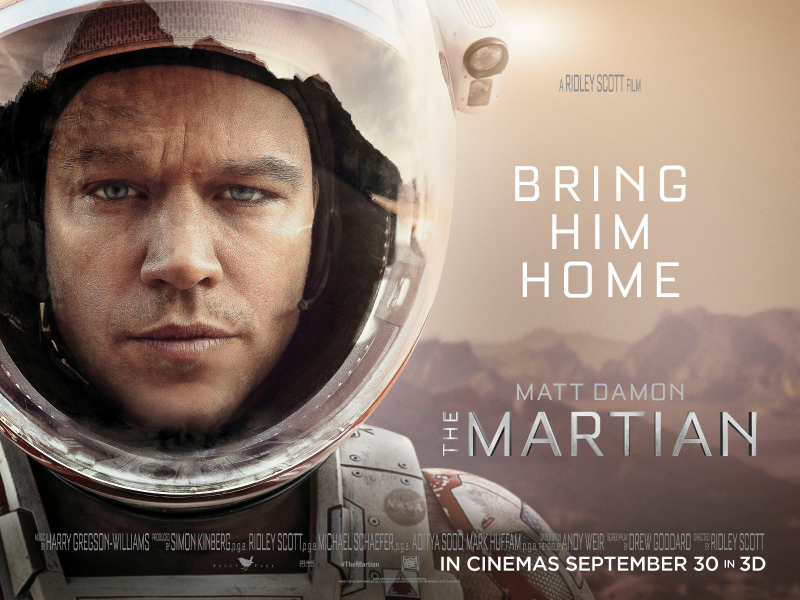
Review: Get out the duct tape — ‘The Martian’ is one of 2015’s best films
By Louis Grelot, GSS film critic
PARIS — “The Martian” is a new film by a somewhat troubled director.
Ridley Scott, for some, is the visionary talent behind “Alien,” “Blade Runner,” “American Gangster,” and “Gladiator.”
But for others, he is also responsible for the disappointing “Robin Hood,” the mixed “Prometheus,” and the letdowns that were “The Counselor“ and “Exodus: Gods and Kings.”
With a record like his, there were reasons to be dubious about the quality of Scott’s latest film, despite being based on the eponymous best-selling novel by Andy Weir.
However, if there is one lesson to be learned from “The Martian” — besides the discovery that duct tape is the solution to all problems — it is that no matter how much you can fall, there is always a way to get back on your feet. And by doing that, you can make what is by far one of the best films to have come out in 2015.
Here’s the plot: After being left for dead, astronaut Mark Watney must find a way to survive on Mars without any hope of being rescued. What ensues is two-and-a-half hours of great scientific fiction.
Why “scientific-fiction” and not “science fiction?” Because just like the book that it is based on — and like last year’s “Interstellar” — “The Martian” remains grounded in scientific reality throughout its entire story. The film shines as it simplifies scientific language, making it accessible to the audience, something that wasn’t always the case in the book.
 If you’re going to create a modern version of Robinson Crusoe on Mars, you better have a strong lead to interpret this lone survivor. Matt Damon exceeds expectations. The character of Watney, a wise-cracking biologist, is interpreted to perfection by Damon with major psychological and physical transformations occurring throughout the film. Damon is at his best in showing the character’s emotional contrasts, toggling between moments of nearly non-stop humor, and times where Watney is hit by a new obstacle that he may not be able to overcome.
It must be noted that Damon isn’t the only human being in this film; the other characters on Earth and in space are all handled superbly by an all-star cast that shows great chemistry (including Jessica Chastain, Kate Mara, Sean Bean, Jeff Daniels, Chiwetel Eljiofor, and Kristen Wiig). But the real star of the show is without doubt Damon’s Mark Waltney.
 If characters and plot seem to be top notch, what of its execution? Though it’s great to see films move briskly along, “The Martian” could have taken a longer time in the first 15 minutes to resolve a conflict that ends all too early considering its significance. In the book, Watney also encounters key obstacles, which could have been interesting to explore in the film, possibly creating the only opportunity in recent memory where a two-and-a-half hour film could have benefited from a slightly longer run-time.
But overall, Ridley Scott is back in the element where he is arguably the strongest: Space. Though far detached from his classic sci-fi productions, Scott masterfully uses the art of creating tension at key points, and arguably delivers the best use of security-footage as principal photography.
If “The Martian” as a film pales a bit in comparison to the thrilling, page-turning fun of the book, it’s still an enormous accomplishment. Humor, creative tension, and Matt Damon’s acting have restored Ridley Scott’s reputation, and result in a work we can look forward to seeing again.
—Louis Grelot is a senior at the American School of Paris. Email Louis at logrelot@asparis.fr.

Related Posts