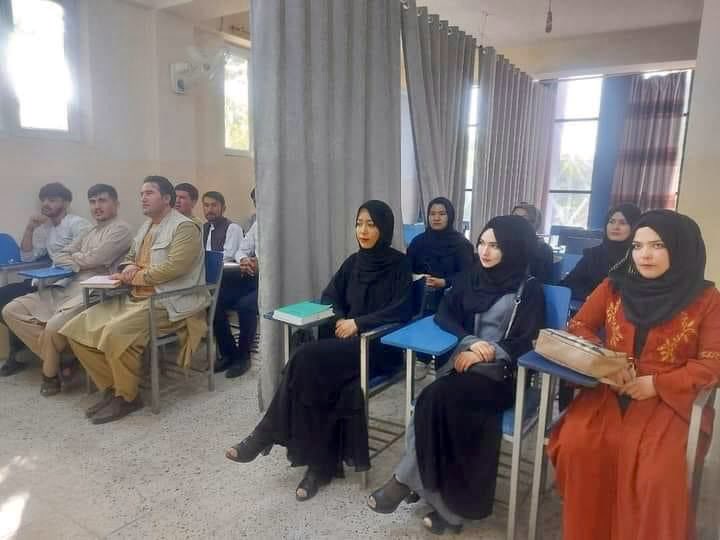
They’ve gone dark: Afghans who helped the U.S. military, trained as American-style journalists and rode the wave of women heading to higher education are destroying the diplomas, transcripts and résumés that prove how they built civil society in the country that the U.S. has left behind.

Reporter’s Notebook: Media needs to cover more than violence in Pakistan
By a GSS correspondent
ISLAMABAD — As I wrote about the recent Bacha Khan University shooting in Charsadda, Pakistan, including interviewing students for their reaction to the latest school massacre, one thing came to mind:
It’s clear that desensitization is not only very real but growing. It’s a problem all over the world because it dulls human remorse. And much of this evolves from our continual and growing attachment to the media.
Take the U.S., for example. In an article entitled “2015 U.S. Mass Shootings: ‘The Sky is Not Falling,'” The Christian Science Monitor reported that there were 22 mass shootings in 2015 in which four or more people were killed, “about one every 16 days” but only “slightly above average for the past 15 years.”
However, in “The Latest American Mass Killing,” The Economist‘s “Democracy in America” blog countered that “(t)he regularity of mass killings (in the U.S.) breeds familiarity.” The post described the reaction that followed a June 2015 shooting in which nine people were shot and killed while attending a prayer service at a South Carolina church.
“The rhythms of grief and outrage that accompany (shootings) become — for those not directly affected by tragedy — ritualised and then blend into the background noise,” The Economist observed.
Unfortunately, at some point in societies where violence becomes frequent, we reach a level where we simply respond to incidents, such as school or church shootings, with absolutely nothing. It seems as if we don’t care! Much of this results from our human nature — humans form habits. This is what helps us discern new information from the old, making it easier for our brains to focus on something we don’t know. Without this biological mandate, every tree would appear as a brand-new tree. But there are other factors to consider as well.
Media not only helps shape our visions but alters our minds as well. Unfortunately, media is tied to viewer ratings. So it is in the best interest of these news providers to produce stories that the audience wants to hear.
Naturally, hot topics such as violence are given preference and with that multitudes of stories may be left behind.
For example, stories like the economic development underway in Pakistan. People all over the world tend to portray my homeland as more of an aggressive region erupting with asymmetrical conflicts. For reasons that elude me, the local networks try to mimic this as if there’s nothing else to report on. Personally, I feel that more of the brighter narratives need to be incorporated. People need to be motivated and there are so many beautiful efforts and communal projects taking place now; reporting on them produces a more balanced image for the nation and naturally how the nation views itself translates to how the world can.
We’ve seen these cases all over the world but especially in Pakistan. Here, the media is more likely to be flooded with the same news of some terror attack again and again rather than some other more innocuous news. And that makes sense. Because more people are inclined to listen to news about terrorism, there’s more and more news about terrorism circling the Pakistani media.
No doubt it is imperative for a nation to encompass informed citizens, but when society is flooded again and again with the same message, it eventually grows numb to the message. With no significant increase in policing and no immediate increased security at schools, the populace feels nothing has happened or changed. There’s no trigger. No impact. But do things really need to get shaky for someone to notice?
The Bacha Khan incident can be compared to the December 2014 shooting at the Army Public School in Peshawar. Because the casualties were higher at APS —140 killed, of whom 132 were children — Bacha Khan seems like a case of violence averted. With an enrollment of 3,000, coupled with the fact that the school was holding an assembly at the time of the attack, the death toll at Bacha Khan easily could have been much higher.
Following the shooting at Bacha Khan, there was unity in the community. Some notable celebrities, notably Veena Malik, a successful Pakistani actress, and her husband, Asad Bashir Khan, came to help the university reopen. Because, at the end of the day, nothing brings Pakistanis together than a collective goal: The eradication of terrorism from the region. These are the people that continue to leave scars every time the nation hears about them. The sacrifice made by Pakistan in the war against terror is phenomenal and must be genuinely appreciated by all.
At the end of the day, there’s no one solution to a crisis. In the short term, yes, there should be increased security in institutions, especially in educational institutes, since the Taliban have already made that their first priority. But we all know this can’t work forever. We can’t always just be on the lookout, as if living in a literal battlefield. We can upgrade security at schools to match our army, but then they could just as easily shift their focus and chose another more susceptible target.
It’s not possible for the state to be at every nook and corner of the nation, anxiously waiting to divert an attack. The only real, long-term solution, is the complete eradication of this plague. And what better way to do it than together?
—The writer’s name has been withheld in order to protect the identity of students involved in this story.

Related Posts