They’ve gone dark: Afghans who helped the U.S. military, trained as American-style journalists and rode the wave of women heading to higher education are destroying the diplomas, transcripts and résumés that prove how they built civil society in the country that the U.S. has left behind.
OPINION: Trump needs lesson in freedom of speech, libel law
By Kellen Browning
GSS Correspondent
DAVIS, Calif. — The list of outrageous claims and declarations that Republican presidential candidate Donald Trump has tweeted, posted and voiced throughout the 2016 primary is, by this point, lengthy and well-documented. So let’s focus on one tenet Trump has attacked that impacts me personally as a journalist: freedom of speech.
Trump frequently lambastes the media:
The failing @nytimes is truly one of the worst newspapers. They knowingly write lies and never even call to fact check. Really bad people!
— Donald J. Trump (@realDonaldTrump) March 13, 2016
Of course, Trump also enjoys disproportionate media coverage. A study by DecisionData.org tracking presidential candidate reporting discovered that Trump received 183,903 mainstream press mentions between June 2015 and mid-January 2016 — more than twice as many as Hillary Clinton’s second-place tally of 87,737.
Still, Trump does not hide his hatred for the press.
At a Feb. 26 rally in Fort Worth, Texas, Trump announced that if president, he would “open up our libel laws so when (newspapers) write purposely negative and horrible and false articles, we can sue them and win lots of money.”
Well, Donald, it turns out you can already do that — if the stories really are purposely false and published with actual malice.
In the 1964 Supreme Court case New York Times Co. v. Sullivan, the Court ruled unanimously that a successful libel suit must prove that a statement was made with “actual malice,” which requires “that the person suing prove that the challenged statement was published by those who either knew it was false or were reckless in verifying its accuracy,” according to the Student Press Law Center.
So Trump need not fear a reckless, combative press; in fact, the “reasonable man/woman” test, as explained by SPLC, holds that a journalist’s story cannot be considered libelous if he or she did everything a reasonable reporter would do: interview sources, take notes, depict the story fairly by getting both sides and fact-check information.
It’s a lesson that high school journalists learn in classrooms all over the U.S.:

What Trump is actually saying, then, is that he wants to restrict First Amendment freedom of press laws and prevent newspapers from publishing unflattering or critical stories about him — in essence, he’s promoting censorship.
Now, that’s ironic. Because Trump also hides behind the First Amendment when criticized about his exhortations of violence at rallies.
In fact, journalists warned that bottled-up anger could spiral out of control long before last Friday’s Chicago protests. A recent Washington Post article titled “Could Donald Trump be held legally responsible for inciting violence at his rallies?” by Philip Bump chronicled some of Trump’s comments about protesters.
Most recently, a Trump supporter was arrested and charged with assault after sucker-punching a protester in the face at a rally in Fayetteville, N.C. on March 10. Last Sunday, Trump backed up his earlier statement, saying he may pay the supporter’s legal fees.

Admittedly, Trump has somewhat distanced himself from the violence. He canceled a rally in Chicago on March 11 over concerns for “the safety of all of the tens of thousands of people that have gathered in and around the arena,” according to his campaign (See “At Trump Rally in Chicago, a Student is Silent No More,” by GSS contributor Michael Regan).
And after speaking with a lawyer, who said, “Short of Donald Trump saying something like, ‘Get that guy and punch him in the face,’ or something like that, I don’t see that he would have any real liability,” Bump’s Washington Post article concludes that Trump’s rally statements — at least legally — are in safe territory.
But maybe they shouldn’t be. Trump’s not shouting “fire” in a crowded theater — the classic example of unprotected speech — but telling an impassioned, rowdy crowd to “knock the hell out of” a protester is pretty close to the equivalent.
Trump rails against the media for exercising its First Amendment right to freedom of the press. Clearly, he does not believe protesters at rallies should be entitled to their First Amendment rights to assemble and speak. However, he continues to defend his First Amendment right to say whatever he wants, and the consequences be damned. As in this widely discredited tweet:
USSS did an excellent job stopping the maniac running to the stage. He has ties to ISIS. Should be in jail! https://t.co/tkzbHg7wyD?ssr=true
— Donald J. Trump (@realDonaldTrump) March 12, 2016
As a journalist, I greatly value the First Amendment — that’s why I urge Americans not to vote for a candidate who has essentially vowed to impose censorship on the nation’s journalists.
But what Trump is saying should not be protected by the First Amendment. For once, I agree with Florida Senator and — until last night —Republican candidate Marco Rubio, who told CNN’s Jake Tapper last Sunday that he is “very concerned” someone might die at a Trump event.
Let’s not wait for that to happen. Instead, let’s recognize Trump’s rhetoric for what it is: A call for violence.
Earlier today, just hours after the latest primary results, Trump warned of what will happen if he arrives at the GOP convention in Cleveland on July 18 without the necessary 1,237 votes to clinch the nomination and the party turns to someone else. “I think you’d have riots,” Trump told The New York Times.
“If you disenfranchise those people and you say, well I’m sorry but you’re 100 votes short, even though the next (candidate) is 500 votes short, I think you would have problems like you’ve never seen before,
he added. “I think bad things would happen, I really do. I believe that. I wouldn’t lead it but I think bad things would happen.”
Let’s call this what a reasonable man would say it is: an incitement to riot. And make it clear that Trump cannot continue in this vein.
—Kellen Browning was recently named California student journalist of the year. He is website editor-in-chief of The Hub, the student publication of Davis Senior High School in Davis, California. He is also a staff writer at The Davis Enterprise. Contact Browning at kellenbrowning@yahoo.com.
Photo credits:
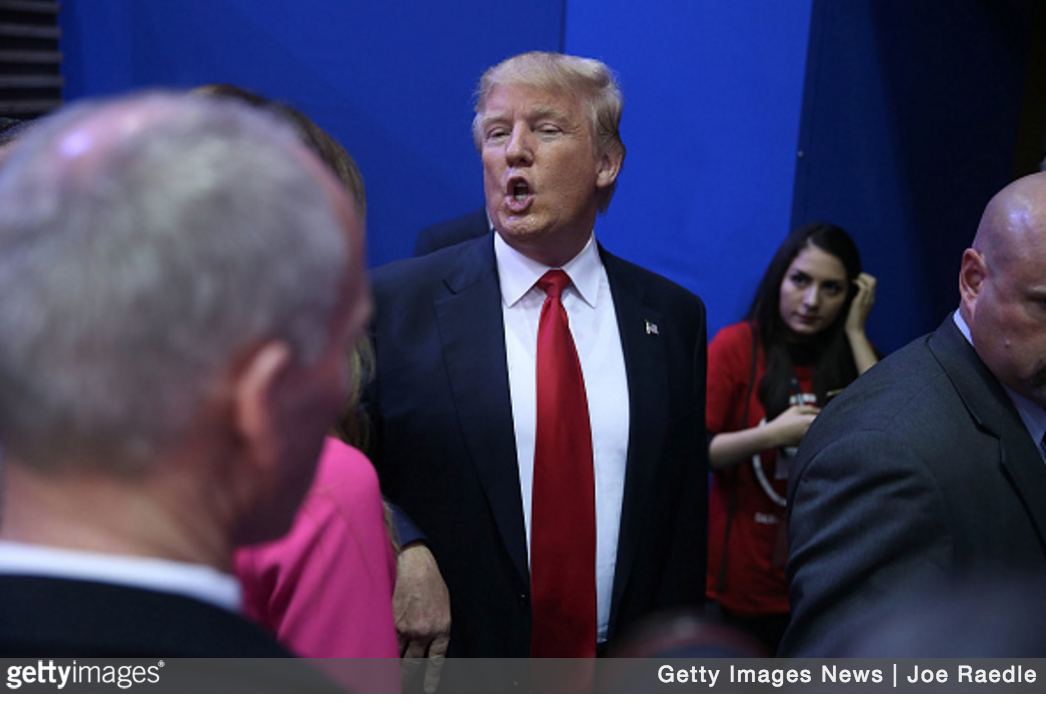
Featured photo: Republican presidential candidate Donald Trump speaks to the media in the spin room after the CNN/Salem Media Group/The Washington Times Republican presidential primary debate on the campus of the University of Miami on March 10, 2016 in Coral Gables, Fla. Photo by Joe Raedle/Getty Images via Camayak.
Photo of protesters: Lynn Caldwell, left, Sylvia Bull and Susan McKay protest before a campaign rally for Republican presidential candidate Donald Trump at Lenoir-Rhyne University March 14, 2016 in Hickory, N.C. Photo by Sean Rayford/Getty Images via Camayak.

Related Posts