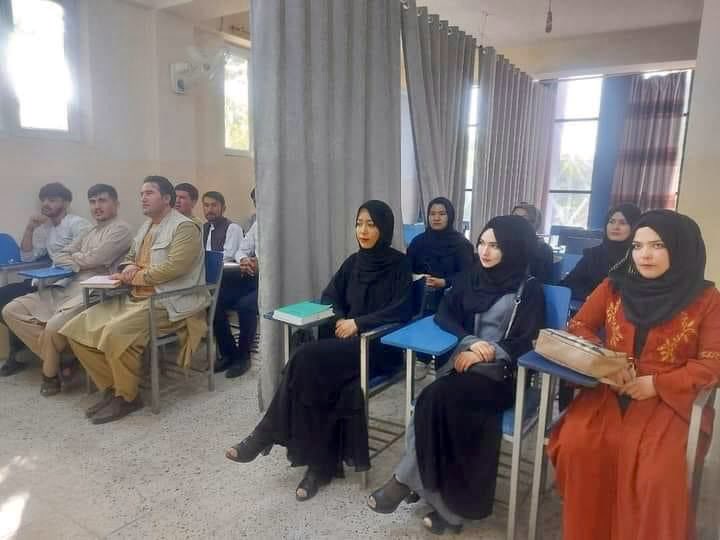
They’ve gone dark: Afghans who helped the U.S. military, trained as American-style journalists and rode the wave of women heading to higher education are destroying the diplomas, transcripts and résumés that prove how they built civil society in the country that the U.S. has left behind.
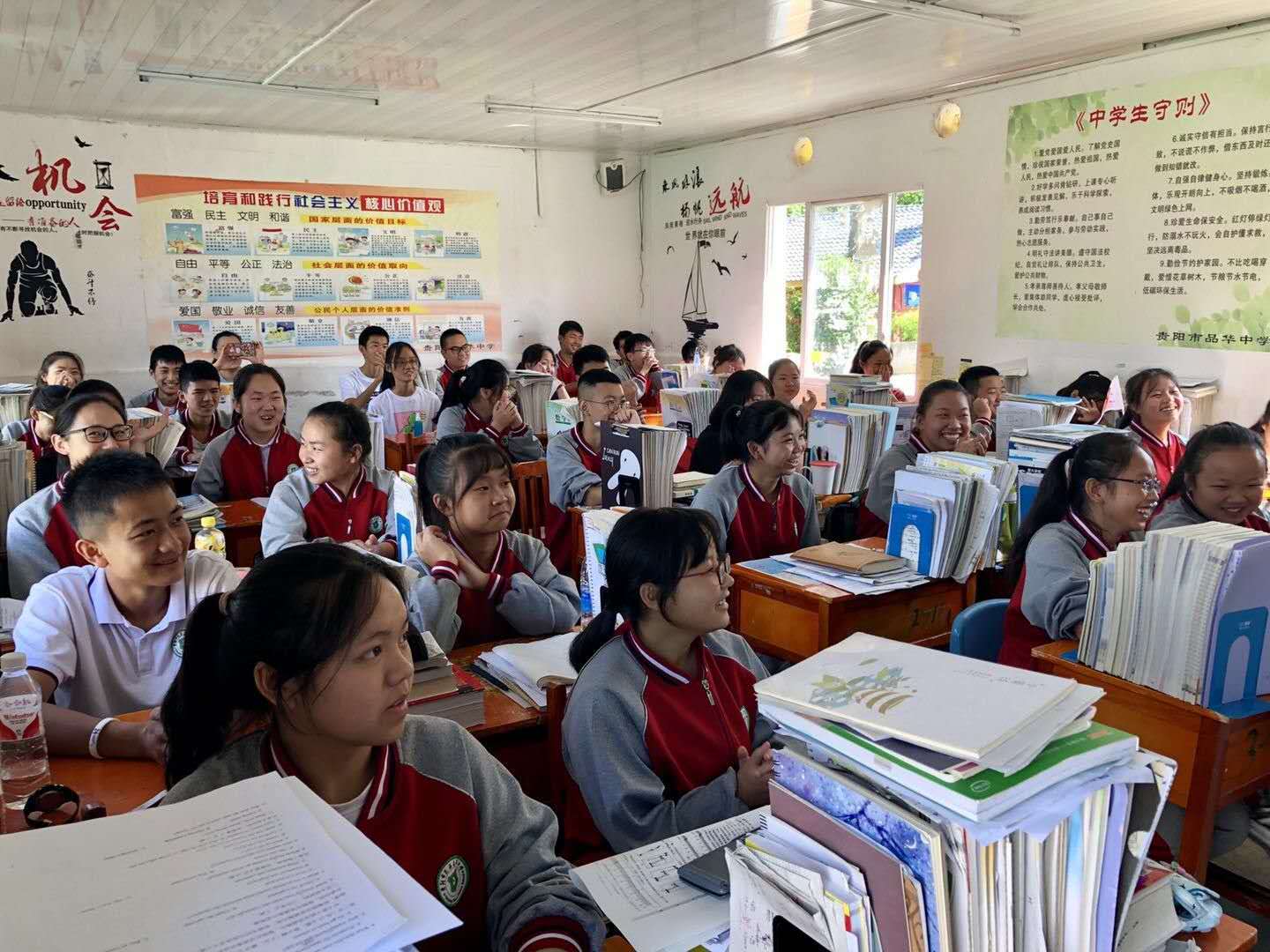
Lost at the starting line: China’s left-behind children struggle in school, life
By Hannah Yvonne Zhou, Jessie Wang, Katelyn Kuo, Moru Park Hyo Jeong, Sammi Liu and Yolanda Ooi, Shanghai High School International Division
GUIYANG, Guizhou province — The answer to an innocent question about what he’d like to say to his parents was heartbreaking.
“I really hope that my parents can care about me more,” said Fuwen Yao, 17, an 11th grader at PinHua High School in Guiyang.
“Is it okay if you encourage me a little? Is it okay if you don’t scold me?” Yao asked.
A city in southwestern China known for its spicy food and ancient hot springs, Guiyang is where Yao was born. But it is located some 1,800 kilometers (1,120 miles) from Shanghai, where his parents live and work.
According to a report by the All-China Women’s Federation, in 2015 alone there were more than 61 million so-called “left-behind” children in rural China “living under the care of relatives or by themselves.” “Left-behind” children are typically under the age of 18 and remain in rural areas while their parents leave to work in cities.
To experience first-hand what these children are facing, surveys and face-to-face interviews were conducted with the students at the small but lively PinHua High School in Guiyang, Guizhou, as well as their parents in Shanghai.
The investigation at PinHua High School revealed the factors that pushed parents to leave and showed that children who are left behind can become disadvantaged in the educational system, forced to cope with potential psychological difficulties as well.
The two sides of city life
Though urbanization has brought economic benefits to citizens all over China, the phenomenon of left-behind children raises questions about how urbanization has impacted families in fast-growing cities such as Shanghai.
Seeking better job opportunities, more than 200 million workers have migrated from rural areas to bigger urban cities, leaving their children behind in their hometowns.
Fiona Wang, a migrant masseuse in her mid-20s from Jiangxi, some 1,000 kilometers east of Guiyang, has two children. Both attend elementary school but only get to meet their mother once or twice every year during spring festivals.
“The bigger one is Wenqiang; he’s going to be 10 next year. The smaller one is only five; his name is Jiayong,” Wang said with a warm smile. “But their dad and I can’t always be there. It is my parents who are taking care of them.”
After dropping out of school in the 8th grade, Wang worked in the textile industry for four years before coming to Shanghai and finding her way into the massage trade. Like the five other parents interviewed, Wang acknowledged that she gets a higher salary working in Shanghai.
“Back in Jiangxi, I used to earn about 100 RMB (approximately $14 as of Nov. 1) every day. Now I get 5,000 (RMB) ($707 USD) every month, which is about 2,000 RMB ($283) more than before,” Wang said.
However, everything comes with a cost.
“My children do not want me to come. They always ask me to go back during phone calls,” Wang said, remorsefully. “But I have to work hard in order to make up for the lack of hard work in education.”
At school, behind from the beginning
Living away from their parents and being able to keep up at school is undoubtfully one of the biggest challenges that left-behind children struggle to overcome. With the help of school administrators, 92 students at PinHua High School completed a survey over a five-day period in January 2019. Many described being unable to meet their parents and teachers’ academic expectations, and feeling enormous pressure both mentally and physically.
“There are many times — when nobody is looking — I would hold myself and weep,” said Jinyang Yuan, a 16-year-old sophomore. “I am a very positive person (and) so are most of my friends. But, there are times when you just can’t help it …. (w)hen you know that you’re in trouble but there’s no way to get out of it, you feel uncertain about the future.”
Yuan said that such uncertainty makes her easily distracted during classes: “It’s already difficult for me to understand what the teacher is saying. Now I’m confused even more.”
Her classmates are facing similar problems. More than a third of the 92 students surveyed wish they could get more help from their teachers and parents, though 79% said that having their parents by their side would not make a difference in their academic studies.
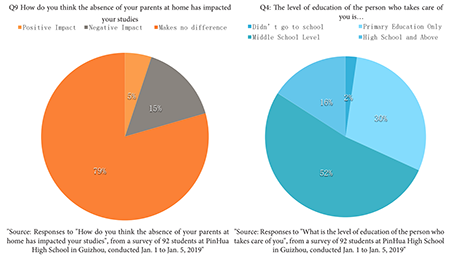
While Yuan believes that the main cause of academic trouble is not getting enough guidance, she believes that even before entering PinHua high school, left-behind teens like her were already lost at the starting line.
“Our academic foundations are really poor. We didn’t meet the benchmark of our middle school entrance examination,” she said, embarrassed. “That’s why we have to study at this private school; we just need to be able to pay for the tuition to get in.”
(Editor’s note: In China, private schools cater to migrant students who do not have the required “hukou” registration papers to attend a free public school; critics say that these private schools sometimes offer a lower level of academic instruction.)
Yuan wants to study in a public school, where she believes she could receive a higher quality education. But that won’t fix the learning gap between Jinyang and other peers her age attending public schools.
Does this system bother Yuan? “Oh, yes — definitely,” she answered.
Another student, a junior named Fuwen Yao, explained that although the local private and public schools in Guizhou use the same textbooks and curriculum, teachers are unable to convey these materials to students because the concepts are too complex and require a strong understanding of basic knowledge.
“They need to start from the very (start), but even that is hard for us to understand,” Fuwen said. Yet in Guizhou, regardless of the type of school, all students face the same final exams as issued by the local government.
“That’s why the test is often so hard for us,” Yao said. “It’s different from what we’re learning in class.”
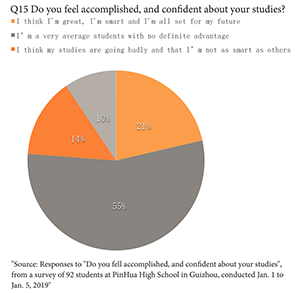
Survey results confirm this: Asked how confident the students feel about their studies, 14% responded that “I think my studies are going badly and that I’m not as smart as others” and 55% responded, “I’m a very average student with no definite advantage.”
In fact, in Guizhou, there is a tremendous gap in the college admission rates between private and public schools.
According to the director of Pinhua High School’s activity department, the college matriculation rate of students in public schools in 2016 was 87.39%. However, at PinHua High School, since 2018, out of the 22 students who majored in science, only two were admitted to college, and only six out of 63 students majoring in liberal arts met the requirement for college admission.
“If you are from Shanghai and attend a good school, you won’t be able to understand how we can earn such bad scores,” Yao said.
Depression, anxiety, fear when loved ones leave
Abby Wu, a high school student in Guizhou whose parents left her behind as a child but returned eight years ago, said that she was not as adversely affected compared to other left-behind students.
“My parents didn’t have a huge impact on my behavior and personality,” said Wu, 16. “Even if they do, I usually don’t show it.”
Yet, other left-behind children are not as fortunate.
Almost 50% of “left-behind” children suffer from depression and anxiety, compared with 30% of their urban peers, according to a study funded by the Heilongjiang provincial government and led by Yang Yanjie of Harbin Medical University that was cited in a 2014 story by The Guardian. A majority of left-behind children psychological problems such as mood swings, stress, and feelings of inferiority, insecurity, lower self-esteem and lower self-confidence.
Even Wu admitted that “I feel slightly insecure when my parents are not with me, especially when my grandparents leave, too.”
One can argue that being left-behind can push children to face and conquer the challenges of day-to-day life, and adopt an adult mindset at a relatively young age. Says Wu: “I think the positive impact of being left behind is being able to make myself more courageous and independent.”
Still, Wu says loneliness and sadness lifted when her parents came back into her life.
“I recognized my parents immediately after I saw them, but I still had a feeling that I was seeing two strangers,” Wu recalled. “(T)hat sense of intimacy felt strange but familiar.”
“I don’t have anything (I need) to say to my parents,” Wu added. “Just the fact that they are here with me is already enough.”
—This story was reported and written by students who participated in JEA China‘s 2019 Youth Observation Contest, where it received a superior rating. It has been edited for publication by Global Student Square and is published with permission. Student Zhang Hanyue of Shenzhen College of International Education provided additional research and factchecking.

Related Posts