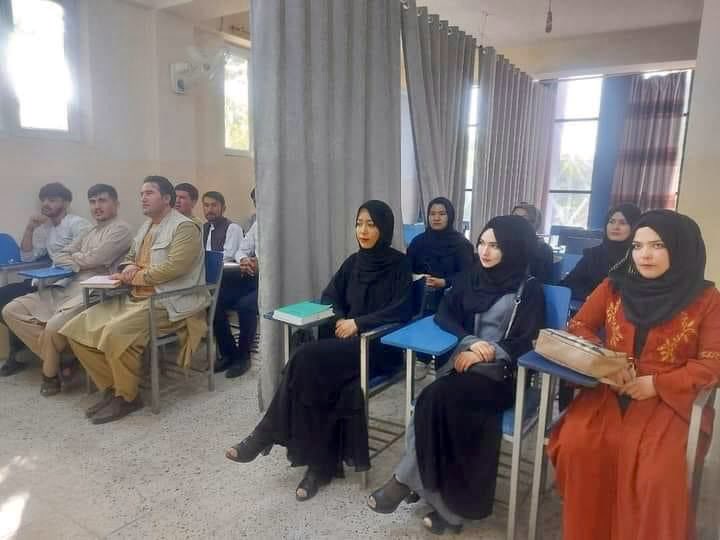
They’ve gone dark: Afghans who helped the U.S. military, trained as American-style journalists and rode the wave of women heading to higher education are destroying the diplomas, transcripts and résumés that prove how they built civil society in the country that the U.S. has left behind.
Day after encampment sweep, refugees return to central Paris
By GSS correspondents at the American School of Paris
PARIS, Sept. 17 — Thirty-four hours after police evacuated a migrant encampment in central Paris, refugees were slowly trickling back to the rough street community that was their home.
A visit to the Stalingrad metro station on Saturday afternoon, the epicenter of the encampment, found small groups of young men and boys gathered nearby along the Avenue de Flandre, some in tents and some simply standing and talking.
Residents of the neighborhood sat on benches and watched, some shaking their heads at the aftermath of the police evacuation that took place at dawn on Friday morning.
“C’est pas normale, les gens dans la rue (it is not normal that there are people on the streets),” said Imed, 41, from Tunisia.
A resident of the Stalingrad neighborhood, he declined to give his last name but opened his wallet to a reporter to show that he has papers as a legal resident of France.

Police evacuated the encampment, estimated at 2,100 people, at 6 a.m. last Friday. According to published reports, the majority of the migrants were from Sudan, Eritrea, and Afghanistan. Mayor Anne Hidalgo announced on Sept. 6 that Paris would open two refugee camps in mid-October in an attempt to provide social services to refugees and prevent informal camps such as the one at Stalingrad.
Olol, 26, from Somalia, said that prior to last Friday police came infrequently to the Stalingrad encampment to check papers and removed those who had none.
“We are here to get home,” he said in English, adding “I am expecting nothing.”
“You have to try also to help us,” he said.
Before the Friday sweep, sidewalks near the metro station were carpeted with mattresses and tents. On Saturday, a garbage truck could be seen stuffed with mattresses that had been left behind.
Only a few tents remained. A young man sat in one of them, wearing a “Lightning McQueen” hat from the pixar movie “Cars,” black-and-red sneakers, and black, green and yellow beads on his wrist. Nearby, people in other tents were changing clothes or sleeping.
Though he declined to give his name, the young man, 27 and from Eritrea, was ready to tell his story. He had been in Paris for 50 days, he said.

“It’s not human,” he said in English, referring to how migrants are being treated in Paris. He added that he had been taken in the sweep to a shelter and offered a bed but no food. Others from the Stalingrad camp also were taken, according to the man, but all returned on Saturday.
The man said that he planned to go to England or Denmark, countries where he believes refugees are given more financial and social support.
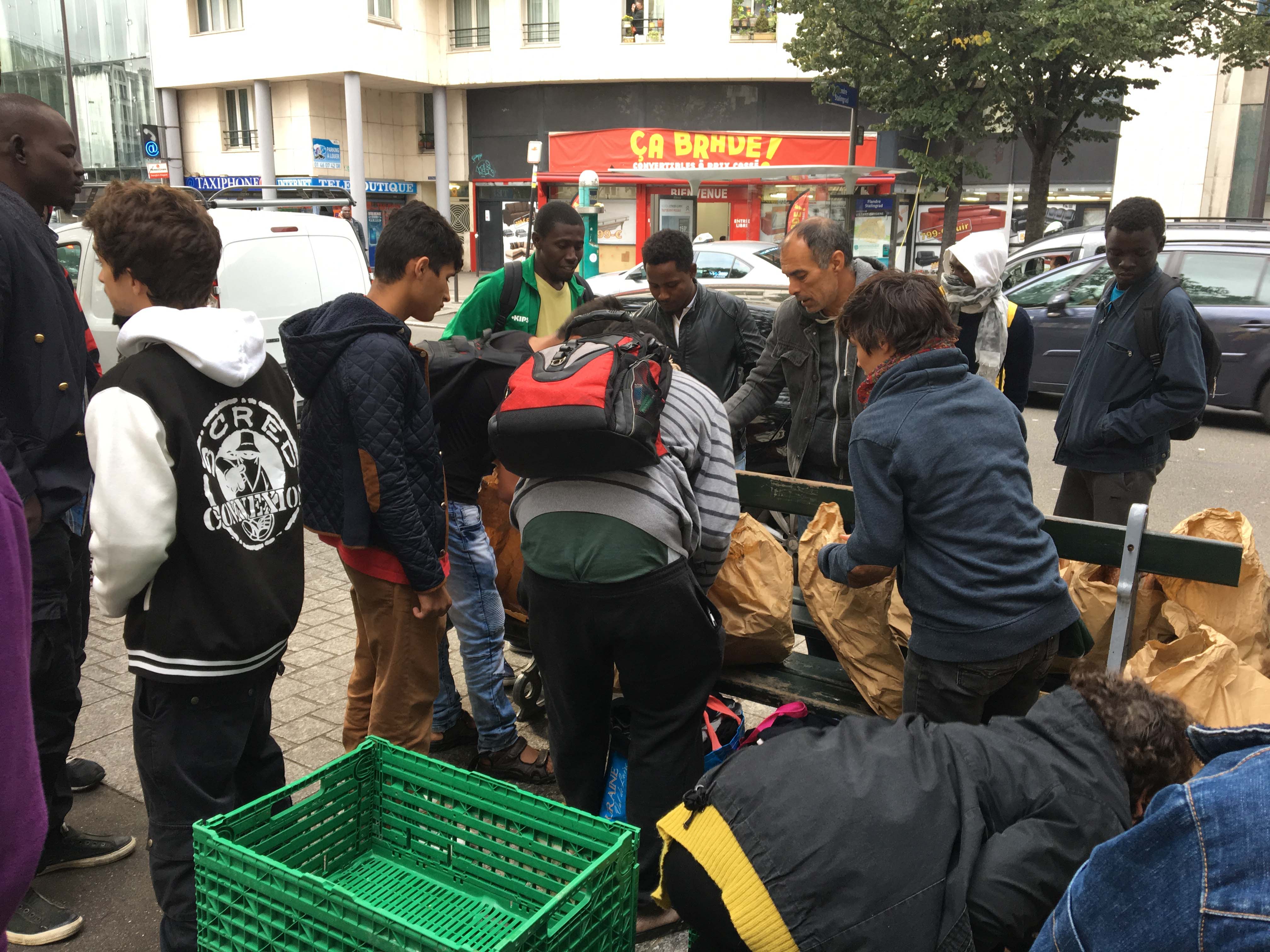
At approximately 5 p.m., refugees began forming on the sidewalk in the middle of Avenue de Flandre as volunteers arrived with flats of torn-up baguettes and bottles of Evian. The food was donated by local supermarkets and bakeries, according to Hugo D’Arfeuille, a volunteer.
Though the meal was meager, refugees said it was more than they had in the shelters to which they were taken the day before.
“The house (is) not eating,” said a 27-year-old man from Eritrea, trying to explain that the shelters do not offer food to the refugees.

D’Arfeuille, 18, who has been working as a “bénévole” (volunteer) with the Stalingrad refugees for the past several months, said his motivation is simple.
“On est là pour les enfants (we are there for the babies),” he said, adding “c’est un cause qui me touche énormément (it is a cause that moves me enormously).”
In the police sweep, “tous les familles avec enfants a été logées (all the families with children were housed),” D’Arfeuille noted, adding that this was a positive step.
However, many refugees lost personal items as the encampment was broken up, especially legal papers which may be impossible to replace.
“Après, ils (ont) jeté tous les affaires (afterwards, they (the police) threw out everything),” D’Arfeuille said. “Papiers, l’argent, tout, tout, tout (papers, money, everything).”
A resident of the Stalingrad area, Camelio, said that refugees can live for years in Paris without getting medical help or housing.
Frustrated by the lack of social services, from time to time he has allowed refugees to sleep in his own apartment in Paris.
“Ouvrir les frontiéres pour laisser crever ne sert à rien (opening the borders to let (refugees) die is stupid),” Camelio said.
Featured photo: Volunteers prepare a meal of baguettes and water for refugees at an encampment in central Paris on Sept. 17, 2016. Photo by Sloane Valen/American School of Paris.
—This story was produced by the staff of ASPire, the student-produced website of the American School of Paris. It is part of Global Student Square’s special project on global migration. The story was reported by Lenoy Christy, Allegra Knox, Tailor Liedtke, Luigi Maruani, Jessie Oscodar, Louis Serra and Sloane Valen and written by Allegra Knox and Tailor Liedtke.

Related Posts