Young journalists often face contradictions when it comes to talking about social and political issues. Curricula emphasize phrases like objectivity and unbiased coverage, but where do you draw the line?
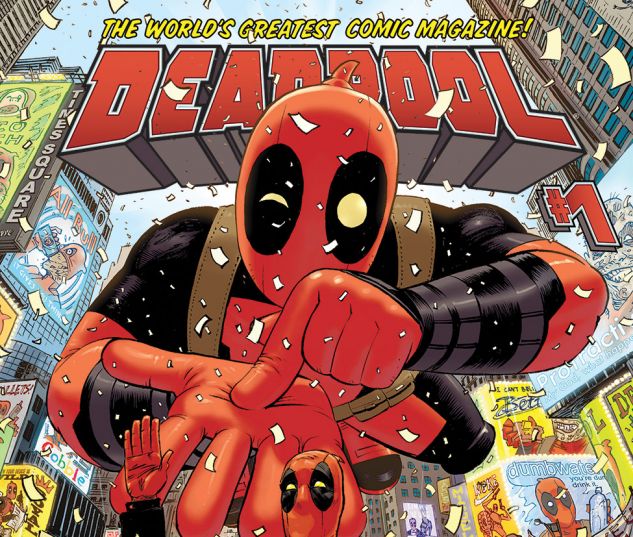
Review: “Deadpool” an instant cult classic — a simple and perfect revenge story
By Louis Grelot
GSS Film Critic
PARIS — Following an extremely underwhelming year for comic book movies — think “Avengers: Age of Ultron” and “Ant-Man” — many were beginning to believe that the genre was starting to show its limits.
Despite high box office receipts, there is only so much a household name can do. It may be a stretch to call those movies unenjoyable, but they were devoid of surprise and audacity.
Yet it only a few months for 2016 to show us that comic book movies can still be enjoyable thrill rides that surprise us at every turn, and be a cinematic force to be reckoned with. Enter “Deadpool,” one of the most outgoing, scandalous, and hilarious anti-heroes the comic book world has to offer.
“Deadpool” is the story of retired mercenary Wade Wilson, who, after being diagnosed with terminal cancer, signs up for an underground experiment meant to save his life and give him superpower abilities.
After discovering the true malign intentions of the men experimenting on him, Wilson escapes, but not before the experiment disfigures him, yet leaves him with the ability to heal from any injury. Wade puts on a mask to become “the merc (mercenary) with a mouth,” and bring down his vengeance onto the men who have disfigured him (he’s cool about the whole invincibility thing):
What this pitch doesn’t capture is how much fun a revenge story can be when it’s seen through the eyes of the wittiest and trashiest-mouthed film characters of the decade … on second thought, probably in cinematic history.
“Deadpool” is not only the best comic book movie in nearly two years; it’s also the most fun and thrilling movie to have come out since last year’s “Kingsman.” And there’s a reason why that’s the case: The two films, at their core, are intelligent spoofs of their respective genres. If “Kingsman” put a twist on the spy movie genre, “Deadpool” goes the extra mile by tearing the comic book genre down to its core.
For those unfamiliar with the comic book character of Deadpool, he’s best-known for being aware that he is in a comic book and breaking the fourth wall (directly addressing the reader). What you get when you transpose this to film is a character who isn’t afraid to make fun of our super-hero dominated film world.
“Deadpool” is littered with golden pop-culture references and pot shots at comic book movies, past and present, and most notably at the interpreter of the character himself: Ryan Reynolds. The actor was born to play the character and has been the greatest advocate of the project ever since it was put into production 12 years ago. Reynolds perfectly captures the physicality, and above all, the personality of Deadpool, and dares to make fun of his previous (and atrocious) portrayal of the character (watch “X-Men Origins: Wolverine” before you step into the theatre and you’ll know what I’m talking about. Needless to say, “Deadpool” is the actor’s best performance.
Director Tim Miller makes his directorial debut with a film paced like a roller coaster, from an original and side-splitting title sequence to its brilliant after-the-credits sequence.
As I’ve hinted, “Deadpool” is an explosion of action and humor with few inhibitions. The humor not only comes from the title character, but also from a lovable and integral cast of secondary characters, ranging from the Russian X-Men titanium giant Colossus to an ordinary cab driver. All of this underscores one key distinction between “Deadpool” and other comic book movies: It purposely avoided a PG-13 rating, choosing to stick to the roots of the of the character rather than widespread box office appeal.
“Deadpool” is an explicit and violent film, but that doesn’t mean that it uses this freedom mindlessly. The violence and profanities blend so seamlessly with the personality of the protagonist that by the film’s end, you’ll understand that there was no way the film could have worked had it been restricted in the slightest. This is also an excellent step for comic book movies as a whole. Writing about “Age of Ultron” earlier this year, I complained that studios were so desperate to target films at a general audience that they cut out possibilities for where some of these films could go.
If “Deadpool” is even half of the commercial success it deserves to be, it could act as a sign that studios (at least 20th Century Fox, which has the rights to the characters of Deadpool and the X-Men) can make successful movies without pitching to the widest possible audience. What’s more, superhero films don’t need a huge budget to succeed: “Deadpool” cost $58 million to make, some $200 million less than Marvel’s latest superhero lineup. Less money led to more creativity and less lavish computer- generated eye-candy. “Deadpool” not only counted its pennies, but even went as far as making a joke out of it:
Only a few hours left for Oscar voting. Too late for a write-in campaign for an ineligible movie? pic.twitter.com/kR4nrRrULv
— Ryan Reynolds (@VancityReynolds) February 23, 2016
One last lesson that comic book movies should learn (yep, there’s a ton to learn from this film about a witty guy in red spandex who isn’t Spiderman) is that the stakes don’t need to be of worldwide proportions for there to be enormous tension at the film’s climax. You don’t need cities falling from the sky or alien galactic cataclysms if you have a simple and perfectly crafted revenge story.
I’ve said that “Deadpool” is the best comic book movie to have come out in a while. But now I’ll go further: It’s one of the best and most game-changing comic book adaptations ever to have been put to film, an instant cult classic. You’ll leave the theater wondering if the rest of this year’s comic book movies will be nearly as good.

Related Posts