They’ve gone dark: Afghans who helped the U.S. military, trained as American-style journalists and rode the wave of women heading to higher education are destroying the diplomas, transcripts and résumés that prove how they built civil society in the country that the U.S. has left behind.
My Take: Keep cops in schools — but respect students’ rights
 By Celine Lopez, GSS correspondent
As more and more videos circulate on social media exposing cases of police brutality, many citizens have questioned how they are treated at the hands of those on the thin blue line.
Typically, we’d associate the presence of police officers with safety, yet the outrage of activists online has announced a widespread distrust.
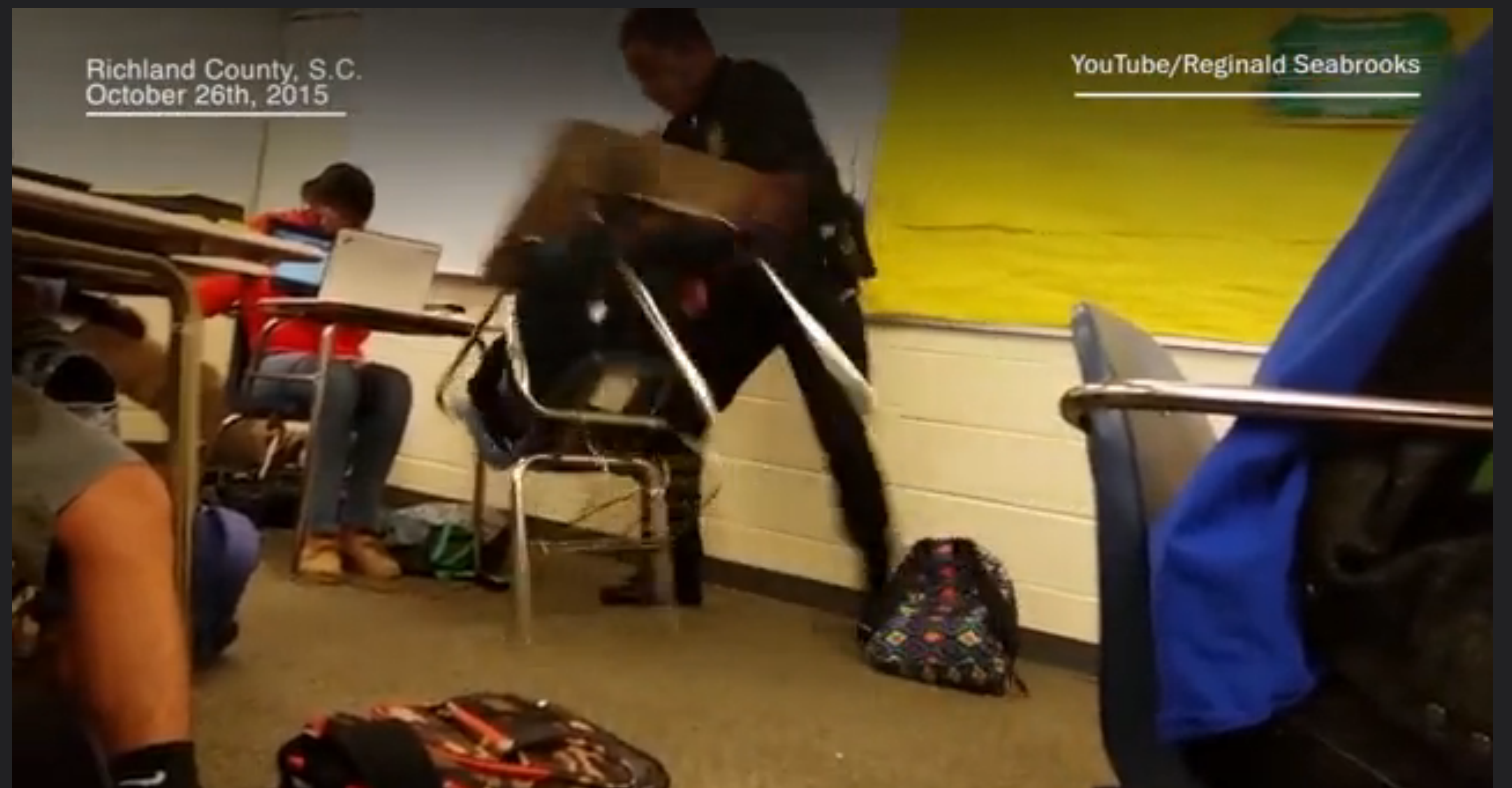
With the recent video that captured Ben Fields, a school resource officer and senior deputy with the Richland County Sheriff’s Department, grabbing and dragging an African American student across the floor of her algebra classroom at Spring Valley High School in Columbia, South Carolina, even students now question their well-being in institutions that promise a safe learning environment.
The Oct. 26 incident was caught on a cellphone:
YouTube upload by Reginald Seabrooks
I keep up with “social justice Twitter,” the community of social activists who speak out against injustice, and where movements like #BlackLivesMatter have gained popularity. That’s where I saw the disgust many people across the nation expressed in regard to this video:
It is NEVER okay to chokehold, bodyslam, toss a child like a rag doll. Seated. Unarmed. Who is training these “deputies”?! #springvalleyhigh
— Gideon Emery (@gideonemery) October 28, 2015
The #springvalleyhigh situation comes down to bad parenting. If you dont raise your kids right, they’ll grow up to assault teenage girls. — chicken permission (@coderedkids) October 30, 2015
I’ve seen white kids fight faculty members in school & be kindly escorted out by the same white staff. #springvalleyhigh
— G(RIOT) (@FlamesBaldwin) October 28, 2015
#SpringValleyHigh isn’t a story about disobedience. It is a story about the trauma kids face daily in the place they should feel free. — Brittany Packnett (@MsPackyetti) October 28, 2015
Some even tweeted that cops do not belong in schools:
Police should not be in our schools. A classroom is not a crime scene. Being disruptive in class is not a crime. #SpringValleyHigh
— zellie (@zellieimani) October 26, 2015
As outraged as I am about #AssaultAtSpringValleyHigh, I simply cannot agree with that statement.
I come from Stockton, an urban community in central California where the possibility of danger invading a school campus has always kept administrators on their toes.
Unfortunately, gangs terrorize my city, and many students are affiliated with them. Fights break out at my school as a common occurrence; in fact, one just happened on Nov. 4. As a high school senior, I’ve already lived through countless lockdowns at my elementary and high schools, due to threats of bombs, shootings and invasion.
Like Spring Valley High School — a campus of about 2,000 students that is about 52 percent black and 30 percent white, according to The New York Times — students at my high school reflect a range of races and ethnicities: 52 percent Hispanic/Latino, 15 percent white and 14 percent black, according to 2011-2012 school year figures from the California Longitudinal Pupil Achievement Data System.
Any student from a large, diverse, urban school knows that what happened at Spring Valley High can happen anywhere. I’ve sat through many incidents of a student being suspended from class due to their behavior, not cooperating with teachers, and being disrespectful.
In one extreme case, my fourth grade teacher — a large black man — had to subdue a boy with anger issues from charging at another classmate by grabbing and holding onto him, knocking over desks in the action. This use of force was necessary as that student was out of control and meant to harm another.
Similarly, at Stagg, we have campus security monitors who patrol the school and stop violence as soon as it breaks out. I wouldn’t want to walk the halls of my campus if there weren’t security guards or police officers on standby, in case my safety was endangered.
But what happened at Spring Valley High was not about safety. The video shows a girl sitting at her desk, confronted by an officer because she reportedly would not put her phone away during class, despite being told several times to do so. When she wouldn’t comply with school resource officer Fields’ directions, he reaches for her neck, then drags her backwards as she still is seated, her desk flipping on top of her.
Never in my life have I seen a student treated this way. Unlike the incident in my fourth grade class, the student did not appear to be threatening anyone. Unlike a fourth grader, a high school student can and should be reasoned with. And the amount of force that Fields used to drag the student out of class seemed excessive and well-beyond what the situation called for. Why couldn’t he talk to her first?
Should the girl have followed directions? Yes, there’s no debate about that. Any reasonable person would not suggest that all cops are horrible, that we shouldn’t have police, and that no one should comply with an officer’s orders. Most would agree that when a police officer or a school security officer tells you to do something, you should follow instructions. Still, the actions of officers such as Fields can’t be justified.
Fields was fired by the Richland County Sheriff’s Department on Oct. 28, just two days after the viral incident. Unlike other incidents, the response to this one was swift. In August 2014, Officer Darren Wilson fatally shot and killed Michael Brown, an unarmed African-American teenager who reportedly robbed a convenience store in Ferguson, Missouri. #JusticeForMikeBrown erupted on social media, demanding that Wilson be immediately fired and charged for Brown’s murder. He wasn’t. He later resigned in November, five days after the Ferguson grand jury decided to not indict him.
What’s different about #AssaultAtSpringValleyHigh? Ultimately, it lies in the fact that the sheriff’s department fired Fields so swiftly. Why? Perhaps it was political pressure. Perhaps it was liability.
But, really, I think the outcome of this case is largely due to the attention and outrage that has been building steadily between the thin blue line and black lives: Brown, Eric Garner, Sandra Bland. America is fed up. We no longer wish to see the same headline recycled weekly, bearing a new name, a new hashtag, a new outcry of injustice.
With the use of modern technology, we are fortunate that bystanders can pull out their smartphones and document these violations. Social media is powering social activism, providing not only evidence but an audience that will push for judgment.
This is why Fields was fired. And this is how we’ll stop inventing hashtags and start saving human lives.
—Celine Lopez is editor-in-chief of the Stagg Line, the award-winning student publication of Amos Alonzo Stagg High School in Stockton, California. Contact Celine at adelaceline.lopez@gmail.com.

Related Posts