Young journalists often face contradictions when it comes to talking about social and political issues. Curricula emphasize phrases like objectivity and unbiased coverage, but where do you draw the line?
Swag, cyberbullies and breaking news — how teens use social media around the world
 I’ve always been interested in the dynamics of individuals interacting online. With so much involvement in new technologies and networking websites, those of us in high school are constantly being reprimanded for spending too much time on the internet. Every day, I see another report coming out about how much time we spend online, how these tiny little screens are killing our developing brains, and how the average teen spends as much time online as sleeping.
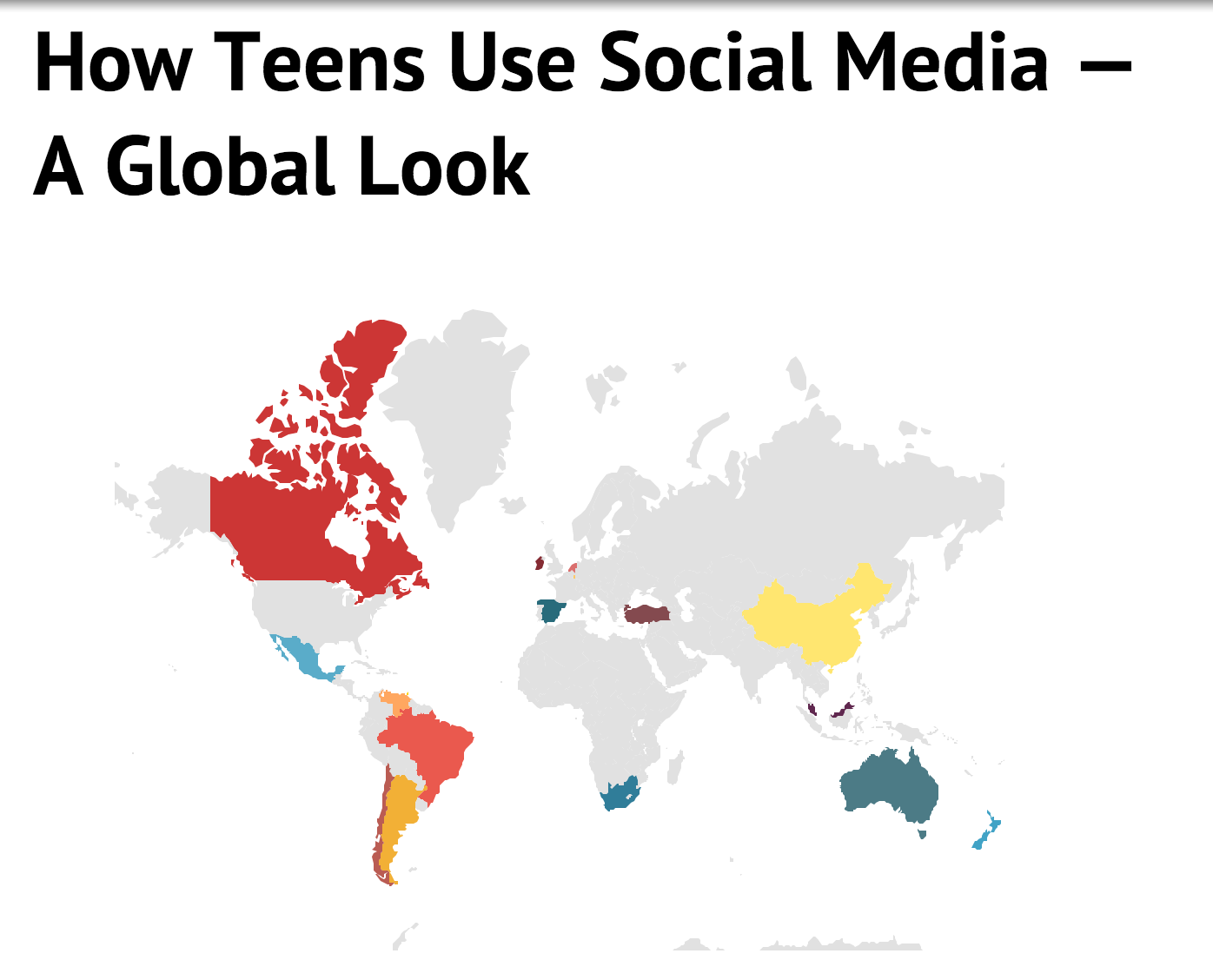
The reality is, I don’t know how much of this is really true. So I decided to do my own little study, by using social media to interview 32 teens from 22 countries, over the course of one month. Here are my results.
A few telling anecdotes came along with these numbers.
Tiffany, 15, who lives in the Ivory Coast, told me: “On Facebook, some teens try to gain as much popularity as they can by going to a photo studio and posting pictures of themselves on Facebook. They do “versus” matches which consists of putting 2 people against each other and telling people to vote for the prettiest, obviously lowering people’s self esteem. These people self-identify as “swags”. They’ve taken it too seriously. They’ve let it infiltrate their schoolwork and personal lives. Even leading some to drop out of school to concentrate on their “swag” career. Ridiculous, isn’t it?”
A “swag career” may sound ridiculous to many young Americans. “Swag” as a word is more often used ironically than seriously nowadays, and my friends couldn’t stop laughing when I told them Tiffany’s story. But these Ivorian teenagers take their “swag careers” very seriously. I didn’t even touch 10 percent of Africa—not for lack of trying — so how do we know swag careers aren’t a trending teen phenomenon in Africa right now?
Another surprise was the number of interviewees who reported that they have been cyberbullied before. In fact, 24 out of 32 interviewed responded that they had witnessed cyberbullying. As a victim myself, I know how distressing it is to have someone take you down over a public social networking site. It can be more than just embarrassing, but also socially devastating. According to NoBullying.com, victims of cyberbullying are more likely to suffer from low self-esteem and to consider suicide as a result.
“It’s sad seeing people send you nasty stuff with not being able to figure out what you did wrong to them,” observed Chelsea, 16, from the Philippines.
Many teens wrote about hiding their identity online. “Usually some people attacks [sic] by insulting and that kind of things to other people who doesn’t like the same things they do, or their opinions,” wrote Camila, 16, from Argentina. “I’ve also seen people that’s being attacked from someone they actually know outside the web, but they use the Internet like a mask.”
Teens had differing opinions on whether social media has a positive or negative impact. “I think social media (has) created a good impact on teenagers,” wrote Isidoro, 16, from Spain. “But we should improve the time we spend on them.”
Edzel, 16, from the Philippines, believes that social media has changed him into a better person. “I became a more open-minded person,” he wrote. “It made me see things from different perspectives. And I can gain knowledge from it that may help my studies.”
As a student, there are obvious downfalls to spending too much time scrolling through Twitter or Tumblr. “As student, it can help because (networking sites are) an easier way to get in touch with classmates and stuff,” wrote Donna, 18, from Mexico, “but (they) can be very distracting too.”
One unique point was brought up by Josie, 14, from England. “I think social media has created a barrier for today’s teens with their social skills, as many are far more confident and self-assured online ,whereas they may not have the same confident social skills offline,” Josie wrote.
Indeed, spending an entire weekend in bed watching Netflix instead of interacting with people face-to-face can make one’s social skills suffer. Someone with thousands of online followers may just have two friends in real life because they haven’t bothered to step off their Twitter timeline. According to a 2011 study published by The Wire magazine, the average American has just two close friends, down from three in 1985.
One of the most interesting things I learned from this project was how teenagers hear about world events. While 30 of the 32 teens I surveyed said they hear about world news primarily through social media, this may not be a bad thing. Through social media, users learn about current events through thousands, if not millions, of different perspectives.
When a subject is “trending” on Twitter, a user can see every single tweet that has included whatever hashtag is the subject. For example, during the recent vote for Scottish independence from the United Kingdom, #indyref was trending for days. In fact, over 3.5 million tweets contained #indyref within just the month of September, according to Topsy.com.
Quite a few of these tweets come from news agencies such as the Associated Press or BBC, or individual journalists with their own accounts. These accredited news sources help teens who are looking through hashtags to gain a sense of reliable news versus online gossip.
Fatima, 17, from Canada, has a breaking news app that sends her instant updates from reputable news sources such as CNN. Four other teens also mentioned getting updates on their phones through apps.
“I often see things on Tumblr or Facebook related to what’s happening in the world,” wrote Gabija, 16, from Luxembourg, “but also the news and of course, people!”
Yasmin, 16, of the Netherlands, believes that Twitter is the only social media site that is not selective in what news one hears about, as it does not filter any trending hashtags. “I do use social media to check on current events, especially Twitter,” she wrote. “I hear a lot about world events on Twitter, but on other social media what you hear is a lot more selective.”
I have witnessed this myself on websites like Tumblr and Instagram. Who any user follows is everything they see; no “breaking news” tweets or advertisements pop up on their feed. On the other hand, Twitter and Facebook both have unavoidable sidebars that display what recent hashtags or keywords are trending.
Though many teens said social media keeps them informed, Kaitlynn, 17, of Canada, finds other ways to stay current. “I often check social media to get info on current events involving celebrities or my classmates/peers,” she said. But for current events like the Ebola outbreak or the turmoil in the Middle East, I usually get my information from the news on TV (my parents watch it in the morning).”
Overall, I found my study to be eye-opening, but many results were also as expected. This project confirmed what I already knew about cyberbullying, while giving insight into unique situations that you wouldn’t know about until you asked. I loved talking to people my age from the other side of the globe, and I received so much information about situations outside of my own little privileged bubble.
Aside from a few people who gave just one-word answers (sometimes because of our language barrier), I heard many insightful comments about the evolution of social media. It was difficult to track down teenagers from extremely diverse backgrounds, some of whom do not have Internet access, but interesting to examine the nuances of teens’ minds and see how culture affects their online habits.
I can promise I won’t be entering any “swag competitions” in the future, though I hope to continue my study and add to my infographic and article as I go. Stay tuned!

Related Posts