Young journalists often face contradictions when it comes to talking about social and political issues. Curricula emphasize phrases like objectivity and unbiased coverage, but where do you draw the line?
Q&A: Writing about “a part of the world that nobody understands”
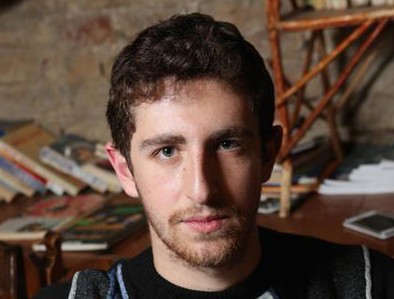
Noah Sneider, 23, is a freelance foreign correspondent based in Kiev, Ukraine. A former student journalist at Palo Alto High School, he graduated in 2013 from Pomona College in Claremont, California.
Sneider’s articles on political and social issues have been featured in The Economist and The New Republic; he has also reported for CNN.
Sneider is active on social media sites, including Twitter, where he posted one of the first tweets from the crash site of Malaysia Airlines Flight 17, shot down over the eastern Ukraine on July 17, 2014.

“It’s a total disaster and a total tragedy,” Sneider told CNN in a widely seen video (below). “The folks on the ground here have very little idea of how to respond to this … it’s not something that really fits into any schema.”
Sequoia high school students McKenzie Anderson and Tyler Ikeda interviewed Sneider by Skype on March 25, with help from Sasha Levin-Guracar, Megan Young, and Nathan Porter. GSS co-editor-in-chief Simon Greenhill edited the transcript and asked the final question.
Ikeda: What got you interested in journalism?
Sneider: That’s a good question. I guess there’s sort of two parts to it. First is that both my parents were journalists (Dan Sneider and Elisabeth Rubinfien, who both worked as foreign correspondents in Tokyo and Moscow, Dan for The Christian Science Monitor, and Elisabeth for The Wall Street Journal). And so I grew up in a journalistic family. I was surrounded by parents that talked about their work and the stories that they had been working on, and I grew up in Moscow when I was a kid because my parents were based there, so I spent a few years there. I was really young and I guess that experience for me was sort of the starting point. I had always heard about tales of my parents’ adventures and got interested in it that way.
I did journalism in high school, but not in college, and I guess the second part to the answer is, I didn’t really sort of intend to become a journalist — it sort of happened that way. I studied Russian in college, which was a really random thing to study at the time, and everyone was sort of asking, “What the hell are you gonna do with that? What good is a degree in Russian studies? Where are you gonna go?” And I just decided that I wanted to live overseas, and after graduation I moved to Moscow. Basically, I knew I wanted to travel, I knew I liked writing (and) I had a vague idea that journalism was one way you could get paid to do both of those things. But I can’t say that I had a great big plan starting out. I just went and things developed from there.
Anderson: When you were our age, what did you think you were gonna do?
Sneider: Let’s see. I held onto my dreams of becoming a professional baseball player until freshman year; freshman year was a reality check. And then at that point, I’m not really sure, honestly. I think if I was being completely honest with myself, I had no clue what I wanted to do, which is completely normal. I should say (that) if you feel like you don’t have a clue (what) you want to do, that’s probably a good thing. I think it was more that I sort of just figured out what things I was interested in … whether it was music or books or movies, etc., just developing a sense of taste. I don’t think I had any sense of what I would do with any of it. I went to Pomona College, which is a liberal arts college, a place where you don’t have to know what you’re doing before you go. I planned to major in international relations. I thought about being a lawyer. I thought about working in politics. I probably thought about journalism, too … I took one international relations class and then, I just got really into studying language, and that kind of started it off.
Ikeda: Why did you go to Russia?
Sneider: (As) I said before, the whole Russia story starts with my family, and the fact that I spent some time there when I was a kid. I spent the first four years of my life there in Moscow, and I grew up speaking both languages. (I) had Russian nannies that took care of me while my parents were working; they were these old Russian babushka grandmas that spoke to me in Russian and sang me Russian lullabies. We moved back to the U.S. and went back to California, and I forgot about all of it and I stopped speaking Russian. Athen we went back for a visit (when I was about (your) age, my junior year of high school) and we met all these people who knew me as a kid and they remembered me and treated me like old friends but I had no idea who they were; they were completely random people to me.
But one of the nannies, a woman who had taken care of me, we met her and she started speaking to me in Russian for, like, 40 minutes. I didn’t understand a word of it, and all I could do was sort of nod and smile. But it made me realize that there was something there that I had to understand if I wanted to understand myself or know what that part of my past had been. So that was sort of what got me into Russia.
(I) just decided to move (to Russia) after school, on a whim. I figured after college is the best time to have adventures. I knew that if I didn’t do it then, then I wouldn’t ever do it. If I moved to Los Angeles or San Francisco or wherever with my friends I would be really happy and I would be really comfortable and I would never leave. And so, I kind of forced myself to go. It was really uncomfortable at first …. I was doing a bunch of odd jobs, teaching English, and this journalism bit on the side. And then when the president of Ukraine fled in the spring of 2014, a good friend of mine who worked at the New York Times bureau in Moscow said, “If you are at all interested in doing this you should go — if I was you, that would be the place I would be right now.” And I took his advice, I just went. That was a little bit more than a year ago, and that just sort of became my life.
Anderson: So, how did you get your first stories?
Sneider: I got lucky. When I first got to Moscow, I got this internship with the New York Times bureau there, because I had good language skills. It wasn’t because I was an incredible journalist; it was a position where you have to read the Russian media and do interviews and do research for other people and sort of learn the ropes along the way. So I worked there for a summer and helped out on other people’s stories and I started pitching things myself.
Basically, how it works is you come up with an idea, and you take it to the editor or the head of the bureau and say, “I want to write a story about this, here’s why I think it’s important, here’s how it will look.” And then they either tell you to “go for it” or “no, it’s a terrible idea, sit down, shut up, keep thinking.” So the first stories I did were all things that I noticed and pitched. Sometimes, though, the news is what it is and you don’t get much choice for a story. Something happens and you go to the place where the thing is happening and you write about it. And that’s one type of story the news takes. Feature (stories) are things you have to search for and bring to your editor’s attention.
Ikeda: What is the work you’re most proud of?
Sneider: Well, I wrote a really long story that I called “The Empire Strikes Back” last year, a big overview — 10,000 words — tying together all of my experiences in the Ukraine and the history (of the country). That was the piece that I put the most time and effort into. I thought it came out pretty well. I felt like I had said something that might have contributed to people’s understanding of what is going on. I guess for me that is the most meaningful one, because a lot of the stuff you do, the daily news or (the story that) goes into a weekly magazine or a daily newspaper, a lot of it gets old really quickly. It’s about the events; someone says something and then the moment passes, and it doesn’t really stand up overtime. So I think (Empire) is the story that would hold up.
Anderson: What’s your favorite part about your job?
Sneider: I think the first (favorite part) is probably that I get to travel. My job requires me to go to new places, interesting places, sometimes uncomfortable places. You have to be into it for it to be fun. But yeah, I love that I get to see new parts of the world. And the second thing is that my job is all about people; about meeting new, interesting people; people that are doing interesting things. And talking to them. So I spend a lot of my time getting to know about people who are making news, or who are making things happen in the world. Or people who are also just caught in the news, people whose lives intersect with events in the world. I think those human connections are incredibly valuable. It beats sitting in an office any day. I think I would go crazy if I had to do a normal job now.
Ikeda: What is the hardest part of your job?
Sneider: Writing, I think. Writing is, and will always be, a difficult, painful process. It feels great when you’re done, but while you’re doing it, it’s tough. And it’s really tough to write on deadline, to write about complicated things going on in a part of the world that nobody understands, in a way that everyone can understand it. It’s difficult.
Anderson: Tell us about your experience with the Malaysia Airlines event? What happened? What did you see?
Sneider: That was the most insane day of my life, no question. I was in Donetsk, a city in eastern Ukraine, that’s held by the (Russian) separatists. And I had been traveling and working in the area for a few months, and at that point it was a pretty quiet phase, so a lot of the other journalists had left and there were only a few of us in town.
We heard reports of this plane being shot down, which we at first thought were fake — there was no way. And then more evidence started pouring in and we decided we had to go and at least look. So we went to the place where everyone said it was, and of course it was very much there. And, we drive down this road, it’s this empty field in the middle of eastern Ukraine, parts of which looks like this world was stuck in the 18th century, like little villages. We were driving through some of those and finally got to this (crash) site, and we could see some smoke rising in the background, and the rebels who normally were really hostile and gave us a lot of trouble at the checkpoints were just waving us through, because everyone was just so shocked as to what had happened.
Nobody had any idea what to make of it, and we were there pretty early on. (We drove) up, and it’s this field full of human bodies and peoples’ belongings. And it was by far the most terrible thing that I have ever seen.
Normally, in a situation like that, you wouldn’t have access to the site. Normally, the emergency services would come, and they would (block) it off and there would be police tape, and if you were a journalist you would look from far away. But because this happened in the middle of a war zone, where there is no government or state, there was no authority that could deal with it, so it was a free-for-all. And there were local firefighters, and local people, local rebels, and tons of journalists.
We spent the night there because we thought they would block it off by the morning, so we stayed with three to four other colleagues. Some of them slept in the car, some of us couldn’t sleep at all; we just waited by the side of the roads. And, yeah, it was completely nuts. I don’t really know how to describe it, to be honest.
Greenhill: What’s next for you?
Sneider: I hope to keep traveling and telling people’s stories. I’d like to remain in Russia, Ukraine and the post-Soviet space, though east Asia also fascinates me. In general, I plan to go where the story takes me — the fun part of it is that I have no idea where that will be.

Related Posts