They’ve gone dark: Afghans who helped the U.S. military, trained as American-style journalists and rode the wave of women heading to higher education are destroying the diplomas, transcripts and résumés that prove how they built civil society in the country that the U.S. has left behind.
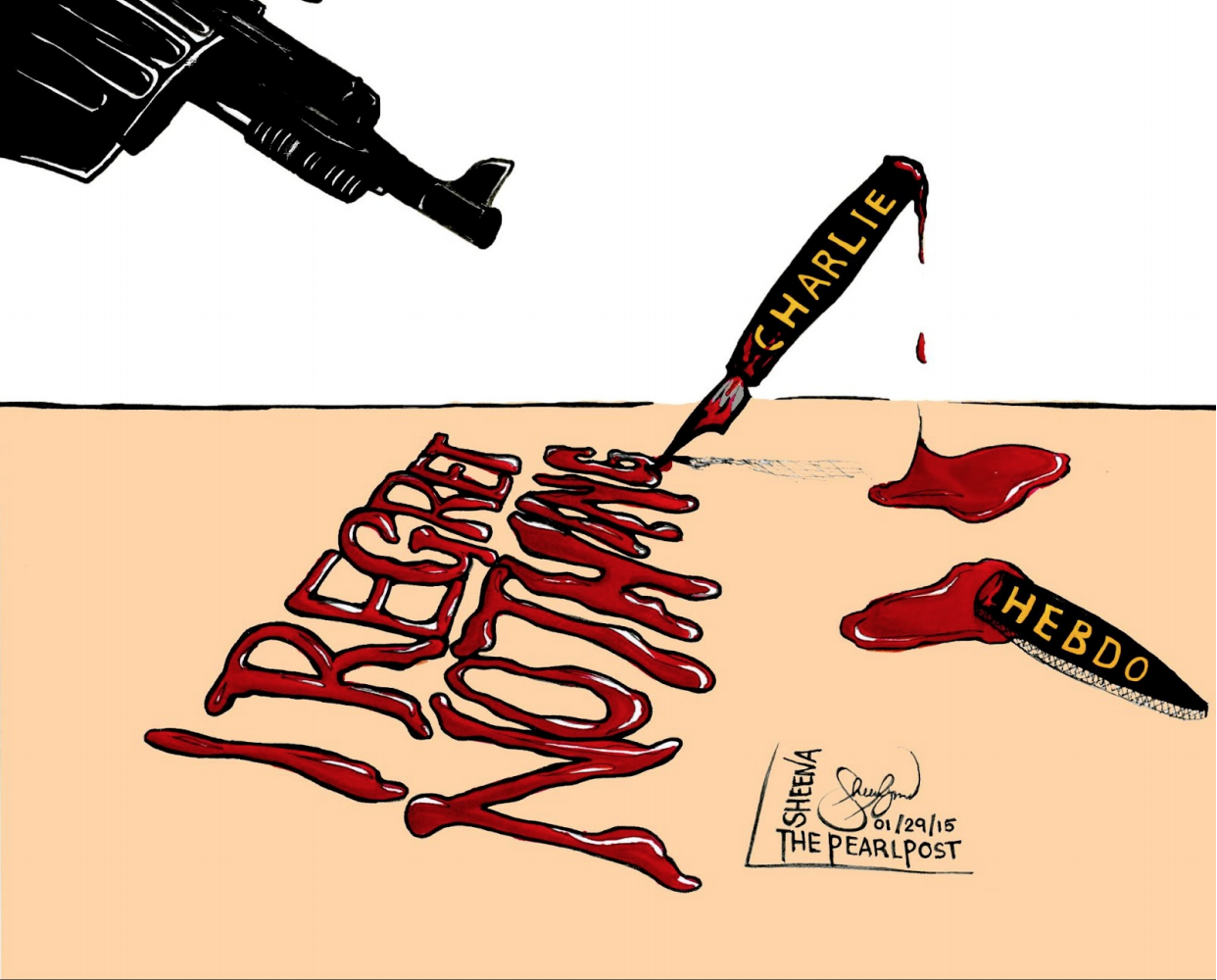
Commentary: Nieman Reports highlights cartooning after Hebdo
By Jack Brook
Palo Alto, California
GSS Correspondent
Five months after the Charlie Hebdo shootings, the latest issue of Nieman Reports covers “The Offending Art: Political Cartooning After Charlie Hebdo,” which examines the role of satirical art in the 21st century.
Given the efficacy of a cartoon — which elicits an immediate, visceral reaction — it’s no surprise that cartoons are becoming an ever more popular news source for those with busy schedules and short attention spans (i.e., almost everyone) seeking to stay up to date with world affairs.
Yet cartoonists in countries such as Syria and China have been forced to publish their controversial work outside of traditional media outlets due to censorship and fear of repercussions from government and religious authorities. While cartoonists in the West may face less oppression, they still face an increasingly fervent atmosphere of political correctness. With über-correct societies on one side and hostile regimes on the other, what room is left for political cartoonists, Nieman Reports asks?
The legacy of Charlie Hebdo presents an interesting case study: Were the cartoonists at the French magazine “punching up,” as the Nieman article puts it, by attacking those with power? Or were they demeaning Muslims, an often-disenfranchised group in Europe?
The answer may be open to interpretation, but the Nieman Reports article strongly re-affirms the necessity of political cartoons, such as those featured in Charlie Hebdo, as a means for opening critical dialogues about current events and putting pressure on authority figures.
Ultimately, whatever the intent of the Charlie Hebdo cartoons, it’s clear the drawings succeeded, if in a tragic way, in provoking a discussion about the treatment of Muslims in the media, the role of political cartoons and the ethics of free speech. In essence, they provided an opportunity for reflection on issues larger than the magazine itself.
Even in light of the incident last January, Charlie Hebdo has continued to push the envelope. Consider a recent issue, in which a center spread entitled “Le Pen Attacks!” asks “Qu’y a t-il d’aussi dégueulasse que le sourire de Marine Le Pen?” (“What is as disgusting as the smile of (conservative French politician) Marine Le Pen?”).
 The absurd drawings depict various levels of vulgarity — foot fungus, nose hairs and other delightful specimens — but beneath it all there is a clear message about the underlying themes in Marine Le Pen’s politics, and one arguably more likely to resonate with millennials than anything published in a straightforward newspaper.
Millennials are used to receiving information instantaneously, and magazines like Charlie Hebdo are able to make their point without the use of extraneous text. It is also worth noting that Le Pen has been one of the most vocal critics of the French Muslim community, suggesting that Charlie Hebdo truly does seek to critique any and every kind of authority figure, whether he or she is a liberal, conservative or prophet. To the Hebdo cartoonists, it seems to makes no difference.
—Jack Brook was 2014-15 editor-in-chief of Verde Magazine at Palo Alto High School. He will be attending Brown University this fall.

Related Posts