They’ve gone dark: Afghans who helped the U.S. military, trained as American-style journalists and rode the wave of women heading to higher education are destroying the diplomas, transcripts and résumés that prove how they built civil society in the country that the U.S. has left behind.
A SCOTUS watcher with a youth eye on RBG
By Louisa Stuhec
Newsroom by the Bay Now 2020

ANN ARBOR, Michigan — On Sept. 18, 2020, a nation fell into mourning: Beloved Supreme Court Justice Ruth Bader Ginsburg died after a long battle with metastatic pancreatic cancer.
“(T)he reaction, anecdotally, was rarely anything I have ever seen before. There was a real outpouring of support and remembrance from people,” recalled Anna Salvatore.
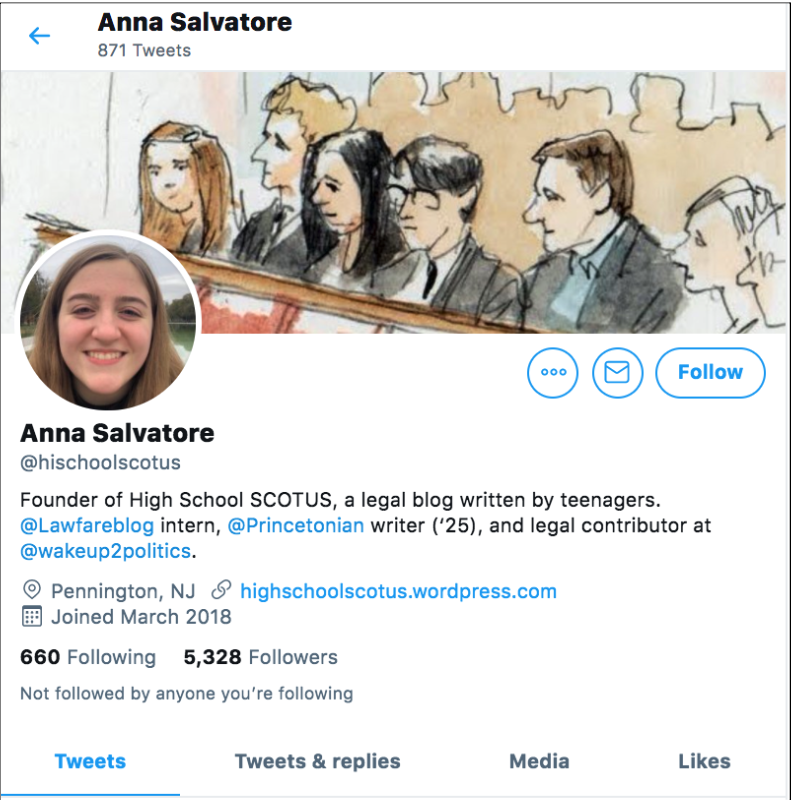
Among the many SCOTUS experts and pundits who reacted to the news was Salvatore, a longtime Supreme Court observer who began her career nearly three years ago — as a high school student.
Salvatore, 18, created High School SCOTUS, which bills itself as the nation’s only Supreme Court blog, written by teenagers.
After graduating in May from Hopewell Valley Central High School in Pennington, New Jersey, Salvatore is taking a gap year and plans to join the class of 2024 at Princeton University. There, she will write for the campus’ daily student news publication, ”The Daily Princetonian.” In the meantime, she is an intern writing for Lawfare—a blog about national security, law and policy that is published by the Brookings Institution, a Washington, D.C., think tank.
Reflecting on Ginsburg’s legacy, Salvatore said that the late justice “meant a lot to people. Most kids our age, if they had to name a single Supreme Court justice, they would probably come up with (Ginsburg).”
Widely known as “the Notorious RBG” for her resounding dissent in 2013 after the court struck down a key portion of the Voting Rights Act in Shelby County v. Holder, Ginsburg was a pioneer in establishing the constitutional interpretation of discrimination on the basis of sex.
Salvatore particularly admires Ginsburg’s unique, incremental approach throughout her work as a lawyer heading the ACLU Women’s Rights Project. At a time when the role of women was confined to housework, and women’s rights landmark cases were unprecedented, Ginsburg looked to the big picture, Salvatore says, noting that Ginsburg took cases to court in which men had been penalized by laws that attempted to draw distinctions between sexes. Case-by-case, Ginsburg used this strategy to tackle gender discrimination.
“If a man was discriminated against in a law, she would say that it’s not fair to stereotype men as the breadwinners; they can also be in charge of childcare,” Salvatore explains. “By striking down the stereotypes that affected men, she made it easier for the court to see that stereotypes against women were oftentimes equally pernicious.”
As a result of Ginsburg’s resilience and strategic approach, her supporters believe, women in professional careers today face vastly fewer barriers from traditional gender norms.
“There’s been a sea change in women’s access to the law,” said Salvatore, citing a landmark 1873 Supreme Court ruling in Bradwell v. Illinois , a case involving “a brilliant lawyer who was denied the right to practice law because she was a woman.
“A little over a hundred years later, there was the first female justice: Sandra Day O’Connor. And now there are three female justices on the Court,” said Salvatore. “There is no longer any doubt that women can perform at the highest levels of the legal system, whether as advocates or as judges or solicitors general. Because of their hard work, I’ve had the luxury of never thinking about my gender when writing my blog.”
Like Salvatore, many hold deep appreciation for the groundbreaking work of Ginsburg. Over the years, the love for Ginsburg grew into a huge fan base—struck by her unwavering strength in fighting gender discrimination alongside personal losses and repeated bouts of cancer.
But Salvatore is wary of how Ginsburg became not only a legal but a cultural icon.
The hype surrounding Ginsburg originated in 2013 from a meme that likened Ginsburg, the “Notorious RBG,” to a rapper named “Notorious BIG.” Ever since, kitchen cupboards store coffee mugs quoting Justice Ginsburg’s wise words. On Halloween, trick-or-treaters can be spotted with hair pulled into a low bun, square-framed glasses and court robes with Justice Ginsburg’s signature decision-making collars. There are movies, books and even RBG fitness routines.
“She became somewhat of a celebrity in a way that’s really unusual for Supreme Court justices,” said Salvatore.
Yet Salvatore believes that the fanaticism over Justice Ginsburg is a function of SCOTUS’ outsized role in American life.
“The court has amassed a lot of power over the past few decades. For instance, it can strike down the Affordable Care Act; it can restrict abortion rights,” she says.
“I hope there isn’t a similar icon on the court now or in the future,” she adds. “I think this mythologizing of a judge is pretty profoundly unhealthy because people see the court more as a hyper-political institution than a neutral, law-interpreted institution.”
To be sure, there is another side to Ginsburg’s legacy.
Critics have suggested that Ginsburg’s fame may have influenced her decision not to resign from her position as the oldest member of the court at the age of 80 during President Obama’s administration, when she could have been replaced by someone more ideologically aligned with her. According to USA Today, Ginsburg is the fourth SCOTUS Justice in over five decades to die before resigning from office. With the ascension of Amy Coney Barrett—who was President Trump’s nominee to fill Ginsburg’s seat—that decision is likely to threaten the advances that she had brought for the cause of equality with issues such as abortion and LGBTQ rights.
However, Salvatore does not believe that Ginsburg’s decision to remain on the bench was irresponsible. “At the time, Justice Ginsburg was ably performing her work, and it sure seemed like one Democratic president would be replaced by another. She calculated the risks of staying on, and it turns out that she calculated incorrectly.”
Ginsburg courted controversy in other ways. Salvatore cites unusual appearances and comments that Ginsburg made during her career. For example, in 2016, during a media tour for her newly released book, “My Own Words,” Ginsburg was asked about Colin Kaepernick, an NFL player who knelt during the national anthem as an act of protesting racism. In an interview with Yahoo News’ Katie Couric, Ginsburg did not acknowledge concerns over police brutality. Instead, she compared Kaepernick’s move to flag burning and called it “dumb and disrespectful.”
The rights of Indigenous people to land is another such issue. “It’s fair to say that Justice Ginsburg had a mixed record on native sovereignty,” said Salvatore.
Ginsburg wrote the majority opinion in City of Sherrill v. Oneida Indian Nation of New York, in which the Oneida Nation sought to reassert its authority over land that had been illegally seized by the state of New York in 1788. The Oneida had recently purchased certain parcels of the land, and thereafter claimed they were not liable to pay taxes on it.
Ginsburg noted that more than 200 years had elapsed since the land had changed hands. As such, the Supreme Court majority overturned a lower court ruling that supported the tribe’s demand. According to an article by the Marshall Project, a nonprofit journalism organization that covers criminal justice, “The language in (Ginsburg’s) opinion is considered some of the more overtly racist language in its challenge and skepticism of tribal interests.”
On the other hand, Salvatore points out that Ginsburg, “was a key vote in two pro-Native cases, one involving Lake Coeur d’Alene in 2001 and another declaring that half of Oklahoma was Native territory in 2019.”
Salvatore believes that Ginsburg’s controversial decisions on tribal land rights will not affect her legacy. “Because her views on indigenous land rights were not black-and-white, as were her views on gender equality or voting rights, I don’t think they will be popularly remembered,” she said.
When it comes to remembering Ginsburg, says Salvatore, it’s a human being we should recall, not a coffee mug.
“RBG has transcended herself, almost, and become a symbol for feminism and dissent rather than a real person. But she wasn’t just a toy for white liberals to play with: she was a member of a powerful judicial body who often wrote strong opinions and sometimes wrote wrong ones.
“That’s how she should be remembered,” said Salvatore.

Related Posts