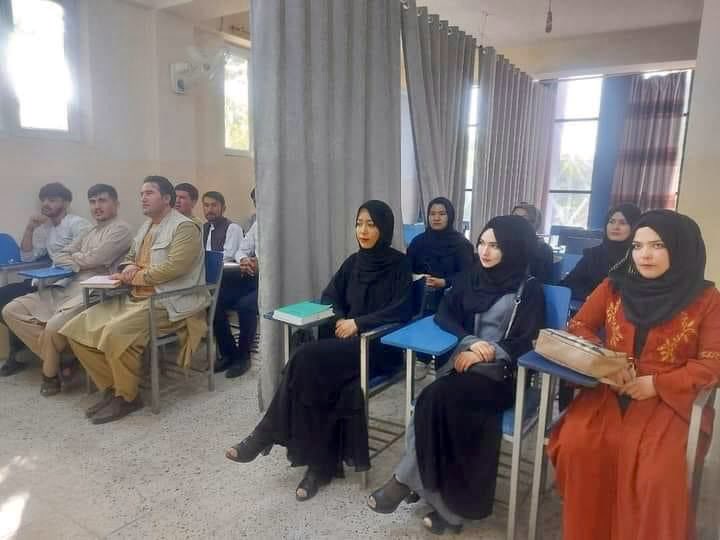
They’ve gone dark: Afghans who helped the U.S. military, trained as American-style journalists and rode the wave of women heading to higher education are destroying the diplomas, transcripts and résumés that prove how they built civil society in the country that the U.S. has left behind.
Sanctuary college campuses prepared as Trump vows ‘big day’ ahead on border wall, refugees
By Sophia Haber
GSS Correspondent
President Donald Trump is expected to sign an executive order on Wednesday targeting cities that refuse to cooperate with Immigration and Customs Enforcement officials in turning over undocumented immigrants, according to several media outlets.
Trump took to Twitter earlier this evening, promising a “big day” ahead including ordering federal funds to be shifted to building a wall on the U.S.-Mexico border, and temporarily freezing admissions of refugees from Syria and other nations whose populations are majority Muslim, a move that could reduce by half the number of displaced persons who are admitted to the United States:
Big day planned on NATIONAL SECURITY tomorrow. Among many other things, we will build the wall!
— Donald J. Trump (@realDonaldTrump) January 25, 2017
According to The New York Times, this would “would effectively bar the entry of people from Muslim countries — including Afghanistan, Iraq, Somalia and Syria — and might prioritize the admission of those who are Christian religious minorities.”
President Enrique Peña Nieto of Mexico is to meet with President Trump at the end of January and his foreign minister, Luis Videgaray, arrives Wednesday to prepare for the Mexican visit.
Trump’s plans are in line with the stated goals of his presidential campaign. Trump repeatedly railed against illegal immigration on the campaign trail, and a statement on his website promised to “immediately” retract the Deferred Action for Childhood Arrivals program, which defers deportation of student immigrants.
“All immigration laws will be enforced — we will triple the number of ICE agents,” Trump declared in his Ten Point Plan to Put America First. “Anyone who enters the U.S. illegally is subject to deportation. That is what it means to have laws and to have a country.”
Well before Trump’s tweet tonight, colleges and universities around the country prepared to become sanctuary campuses, support undocumented and DACA students and pledge non-cooperation with deportations.

On Nov. 18, ten days after the election, Portland State University and Reed College became the first schools to officially declare themselves sanctuary campuses. Since then, 190 schools have begun circulating petitions with the goal of becoming sanctuary campuses, according to data collected by Pomona College student Xavier Maciel.
According to the Washington Post, Maciel was inspired to compile petitions from schools across the country after he saw a petition started by a faculty member at Pomona.
The idea of sanctuary campuses is derived from the concept of sanctuary cities, a term describing cities like New York, Chicago and San Francisco, which have pledged not to turn undocumented immigrants over to federal immigration officials.
For instance, San Francisco’s sanctuary ordinance “prohibits City employees from helping Immigration and Customs Enforcement (ICE) with immigration investigations or arrests unless such help is required by federal or state law or a warrant.”
Public schools are concerned about losing government financial support if they assume a sanctuary status; during an Aug. 31 immigration speech in Phoenix, Arizona, Trump claimed he would end sanctuary cities and block their funding. Since they rely on federal funding, the universities are afraid Trump will cut off their resources as he threatened to do with sanctuary cities on his campaign.
Meanwhile, a lack of legal precedence makes it difficult for private schools to officially convert their campuses into sanctuaries for immigrant students. Sanctuary cities require legal doctrine to lawfully achieve their label, but such policy has not yet been created for private organizations.
For example, although Princeton University has consistently supported DACA, it cannot become a sanctuary campus.
“Colleges and universities have no authority to exempt any part of their campuses from the nation’s immigration laws,” president Christopher Eisgruber wrote in a school-wide email.

Wesleyan University, however, assumed sanctuary status by drafting two clauses outlining how the school would not aid federal actions to deport undocumented students.
“These clauses are meant to give the University legal backing on constitutional grounds in a variety of cases,” wrote the university’s student newspaper, The Wesleyan Argus.
“The most immediate (effect) would be preventing any University staff from assisting federal authorities in deportation efforts,” the Argus said. “The University’s statements also hedge against a potential federal lawsuit or seizure of funds, of which the federal government provides around $200 million to the University each year.”
Though many schools face legal challenges to achieving sanctuary status, they are still taking action to protect their undocumented students. More than 600 public, private and religious schools have signed the “Statement in Support of DACA Program and our Undocumented Immigrant Students.”
“To our country’s leaders we say that DACA should be upheld, continued, and expanded,” the Statement of Support declares. “We are prepared to meet with you to present our case. This is both a moral imperative and a national necessity. America needs talent – and these students, who have been raised and educated in the United States, are already part of our national community. They represent what is best about America, and as scholars and leaders they are essential to the future. We call on our colleagues and other leaders across the business, civic, religious, and non-profit sectors to join with us in this urgent matter.“
Educational leaders are taking action to uphold DACA by meeting with government officials, expressing their concerns and promising to not turn in undocumented students, faculty or staff to ICE.

Among the schools that signed the statement is Trump’s alma mater, the University of Pennsylvania.
“Penn is and has always been a ‘sanctuary’ — a safe place for our students to live and to learn,” president Amy Gutmann wrote in an email to the University community. “We assure you that we will continue in all of our efforts to protect and support our community including our undocumented students.”

Many students around the country are thinking about how recent policy changes in their schools will affect them and their classmates.
“I was talking about this topic with one of my best friends and he was saying that one of his really good friends from home doesn’t know what the status of her parents will be, but the one thing she can appreciate is that she doesn’t have to worry about her own deportation,” Duke University freshman Meredith Manson said.
“I think that as college students we have a lot on our plates, and making sure that students don’t have to worry about the security of their own education can make all the difference,” she added.
The issue has trickled down to the high school level as well; some high school seniors are taking universities’ sanctuary policies into consideration when mulling over options for next year.
“I’m grateful the administration at various schools are taking the necessary measures to address the issue as I begin to decide which school I’m interested in,” Harvard-Westlake School senior Alex Goldstein said.
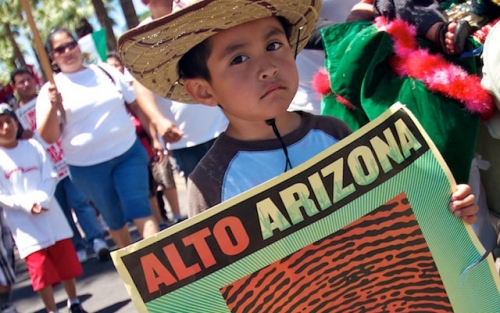
—Featured photo: A boy holds an image of a fingerprint during a protest against Senate Bill 1070 in Phoenix, Arizona, on May 29, 2010. The law, whose original provisions were eased through negotiations with immigration rights groups, originally required police to demand the identification papers of people suspected to be in the U.S. illegally. Photo by Evan Finn on Flickr/Creative Commons 2.0.
Support the Square for more independent student reporting on important issues:

Related Posts