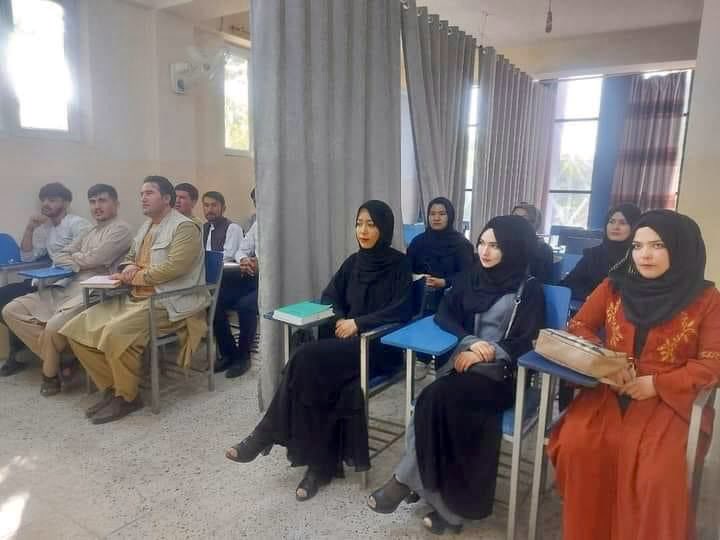
They’ve gone dark: Afghans who helped the U.S. military, trained as American-style journalists and rode the wave of women heading to higher education are destroying the diplomas, transcripts and résumés that prove how they built civil society in the country that the U.S. has left behind.
Despite appeals court decision, Trump stance on immigration worries Korea high school students
By Abby Kwon
GSS correspondent
SONGDO, South Korea — After the U.S. election, the ongoing joke among students at Chadwick International School in Songdo, South Korea, was, “I guess I won’t be going to the States for college.”
But that joke may be the reality for many international students.

International students have long been wary of a Donald Trump presidency. In a June 2016 survey of 1.2 million students from 118 countries conducted by Intead (International Education Advantage), a global education consulting group, approximately 60 percent of the 40,000 students who responded said that they’d be less inclined to come to the U.S. if Trump were to win, while only 3.8 percent said that they’d be less inclined if Hillary Clinton won.
[Editor’s note: The Ninth Circuit Court of Appeals in San Francisco today upheld a lower court decision blocking a Jan. 27 executive order by President Trump, which banned travel from seven Muslim-majority countries, affecting an estimated 25,763 international students, according to USA Today.
But Trump immediately tweeted “see you in court,” an indication his administration will take the case all the way to the Supreme Court.]
In an email response to a GSS correspondent’s question, Rachel Seong, a junior at Chadwick International wrote that “I came to Chadwick in 7th grade with a plan to go to the States for college. But after the election, I’m no longer planning on going to a U.S. college.”
Seong believes “nationalism will rise in the States” and that getting a job there will be more difficult given Trump plans to put Americans first in trade, jobs and other areas of the U.S. economy.
“Also, I’m scared of discrimination,” Seong added. “I’ve seen racism attacks already happening in the States, and I’m afraid I may become another victim of discrimination as well.”
However, not all students share this fear.
“Trump’s election did not change my plan on going to U.S. colleges,” said Jay Lee, also a junior. “Universities have their own reputation and standards and Trump’s election will not affect that.”
Lee added that American colleges “would not be able to reject international students as they are a huge part of the community, and university endowments, as international students pay about two or three times more than local students.”
Trump’s promise as a candidate to scrap the J-1 visa program if he becomes president has prompted special worry among students.
[Trump administration officials are also reportedly considering an executive order that would H1-B visas, which are limited to 65,000 per year for temporary agricultural workers, summer student workers and others. According to USA Today, a draft copy of that order requires that “officials administer our laws in a manner that prioritizes the interests of American workers and — to the maximum degree possible — the jobs, wages and well-being of those workers.”]
According to a report by Project Atlas, part of the International Institute for Education, Korea sends the 4th largest number of students to U.S. colleges, with about 61,007 Korean students studying abroad in the U.S. as of fall 2015.
Ironically, Korea’s employment rate of 96.9 percent means there is plenty of demand in Korea for skilled workers. Yet Korean students are eager to pursue careers in the U.S.
One reason is the small number of top colleges for talented high school graduates: In Korea, there are only three elite schools: Seoul National University, Yonsei University and Korea University. Many students study pre-med and pre-law; other schools or majors are often looked down upon. In a tightly knit society like Korea, reputation is very important, thus college to many students seems like a matter of life and death.
U.S. colleges, on the other hand, provide students with more academic variety, and many Korean students perceive that there is generally less academic pressure than in college in Korea.

Last year, 59 of Chadwick’s 66 seniors received at least one acceptance to a college in the U.S, and of those, 55 or 93 percent enrolled in U.S. schools.
In an email sent to all Chadwick seniors on Nov. 11, three days after the U.S. election, Chadwick college counselor Trevor Russert wrote, “Does the election of Donald Trump mean that the majority of Americans are bigots and racists? The answer to that is no.”
Russert acknowledged that racism and bigotry does exist in the U.S. However, “there are not more racists in the U.S. today than there were last week or last year. Racism and bigotry has always existed in the U.S. just as it has always existed all over the world (even in Korea),” Rusert wrote.
He added that voters between the ages of 18 to 25 “overwhelmingly supported Hillary Clinton” and “those are the people that you will be going to college with.”
Senior Irene Han was recently accepted to Wellesley College in Massachusetts, a “highly selective” liberal arts college where international students make up 14 percent of the population and the acceptance rate was 30 percent as of 2015, according to U.S. News and World Report.

After Trump’s Jan. 27 executive order temporarily banning travel by citizens of seven Muslim-majority countries to the U.S., Wellesley issued a statement advising the college’s students, faculty, and staff from the countries listed in the order “not to travel beyond the borders of the United States” pending “clarity and legal analysis.”
Trump’s executive order named Iraq, Iran, Libya, Somalia, Sudan, Syria and Yemen. South Korea, whose Muslim population was estimated at 0.3 percent in 2015, was not on the list.
For Han, Wellesley was the college of her dreams. But after Trump’s victory, she said, “I was afraid there would be increased discrimination in the States.”
“Especially after listening to Trump’s speeches during his campaign about not wanting foreigners in the country, it scared me even more,” Han said. “My family and friends were also concerned for me.”
In the end, however, she still chose to apply.
“I had been wanting to apply to (Wellesley) since I was in 9th grade,” said Han, adding, “I didn’t let (Trump’s) victory get in the way of my dreams.”
[Reporting assistance by GSS staff. ]
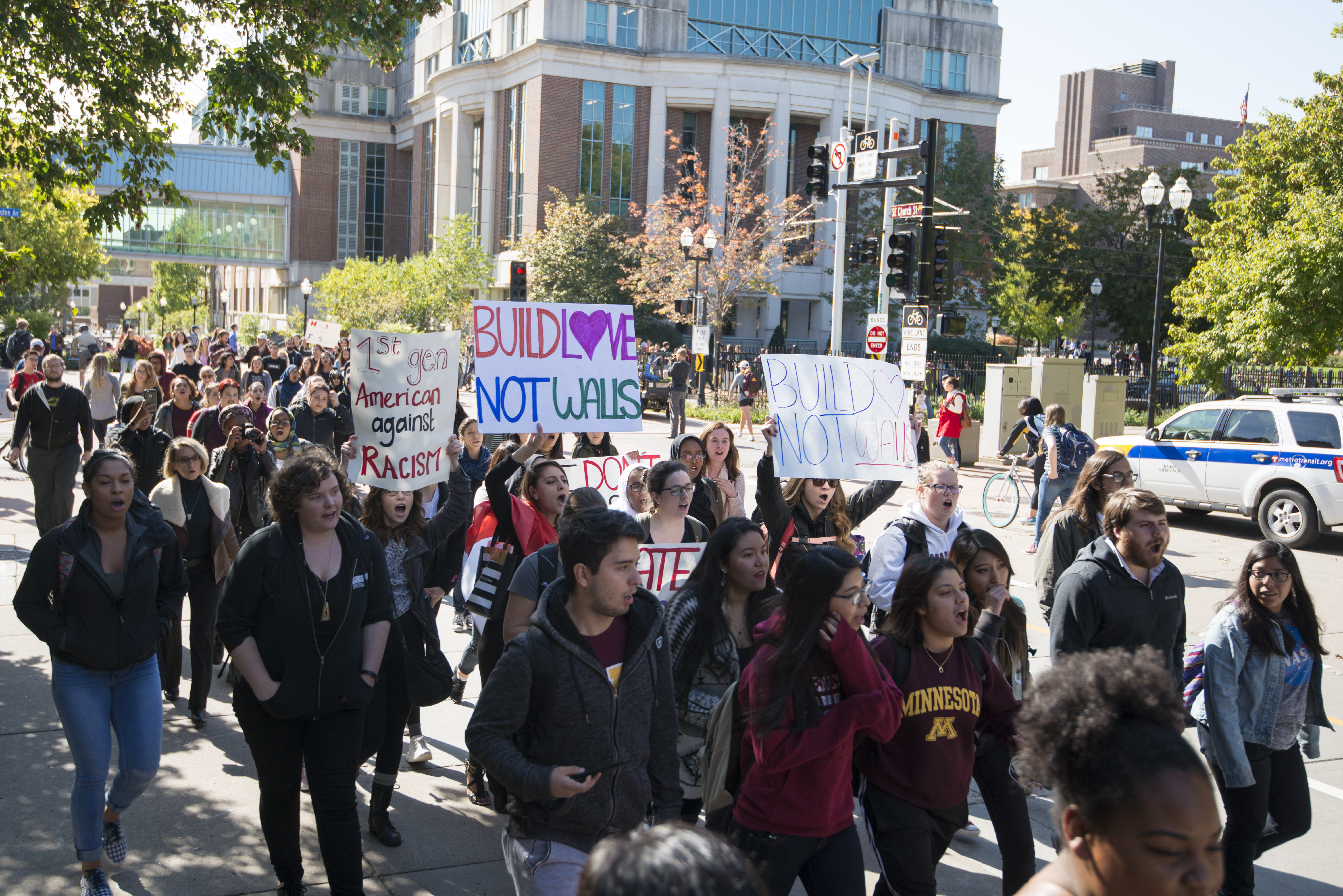
— Featured photo: Protesters marched outside Coffman Memorial Union at the University of Minnesota in October 2016 to protest episodes of racism and bigotry on campus. Photo by Fibonacci Blue at Wikimedia Commons/CC 2.0.

Related Posts