Young journalists often face contradictions when it comes to talking about social and political issues. Curricula emphasize phrases like objectivity and unbiased coverage, but where do you draw the line?
A wooden stick and ‘sheer will’ — the life of bangbang workers in Chongqing
By Li Weike, Wei Danli, Tong Zhexin, Huo Zhixing and Fu Xinyu, Chongqing Nankai International Study Center
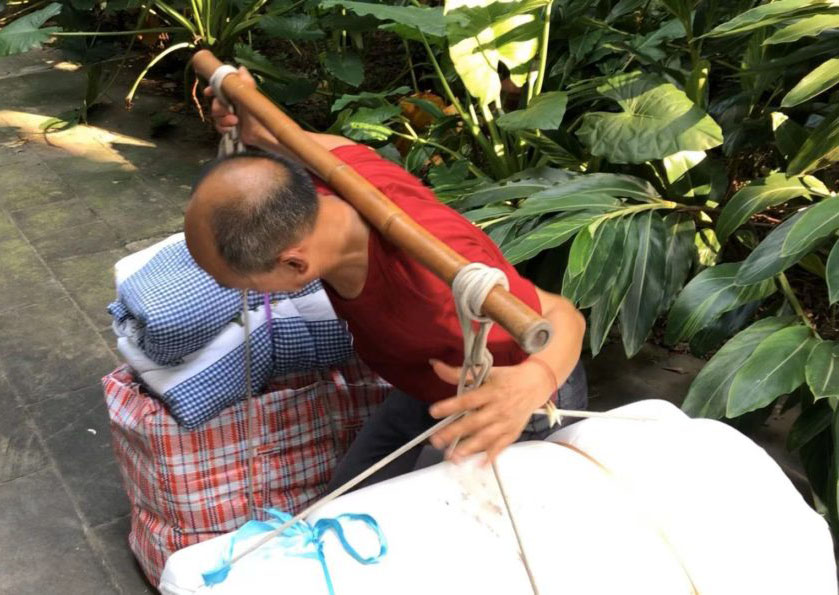
SHAPINGBA, CHONGQING — In the crowded streets of District Shapingba, a scrawny old man in a sweat-soaked white vest slowly squatted down, winding up a package with hemp rope. He tightened the cord and placed the wooden stick across his shoulders to bear the weight. He stood up steadily and began to walk forward.
Lao Jiang, 49, and hundreds of other so-called bangbangs, do this kind of work countless times every day.
The word “
Yet this occupation is on the edge of elimination. According to incomplete statistics, the number of
Bangbang workers now and then
On a recent visit, we observed Lao Jiang, a bangbang worker, who carried a package through the crowded streets of Shapingba. He walked very fast, yet he also looked back from time to time to see whether his employer had kept up with him. Only when he confirmed that was the case did he resume walking.
“Old man, don’t wait for me. Just go ahead straight!”
“No! I worry that you can’t find me and then you’ll believe that I’m stealing your package!”
Bangbangs are legendary for their devotion to the task. Locals tell the story of a fiery summer day when a
“No matter how far away the destination is, as long as we carry the packages on our backs, we will stick to the end,” said Lao as he wiped away the sweat from his forehead with a towel. “Last time one guest had to change (his) destination halfway (through a trip). I took him all the way from Ciqikou to Nankai Secondary School. The long distance and detour did exhaust me, but it is the job, and therefore I must do it!”
Lao turned his attention to his employer.
“Young man, you just asked me to wait for you at the door. Meanwhile I have to refuse several guests. I think you should give me more money!” he said with a grin.
Before anyone could respond, he added, “I’m just joking, we are good. You hired me to carry the load, and therefore, we are one team. It’s up to you to choose what to carry and how far to go. I promise I will finish the job, nice and clear.”
The future of work
Some believe that
Yet they manage to survive amid change.
“In the off season, I usually give help to some moving companies, which may earn me just 100 yuan a day,” said Lao. “During the peak season, however, I don’t need to consider my income. It is good enough to sustain my two kids going to school.”
“Anyway, this is all I have,” Lao added. Addressing our group of reporters directly, he said, “unlike you schoolboys who are going to become big bosses in the future, I just want to do my job well. When the guests are satisfied, I think I am satisfied.”
Lao Jiang put away the hemp rope and wiped the sweat from his forehead with a rag from his pocket. A nearby noodle shop beckoned. “The usual!” Lao cried.
Choosing the best noodles for every customer
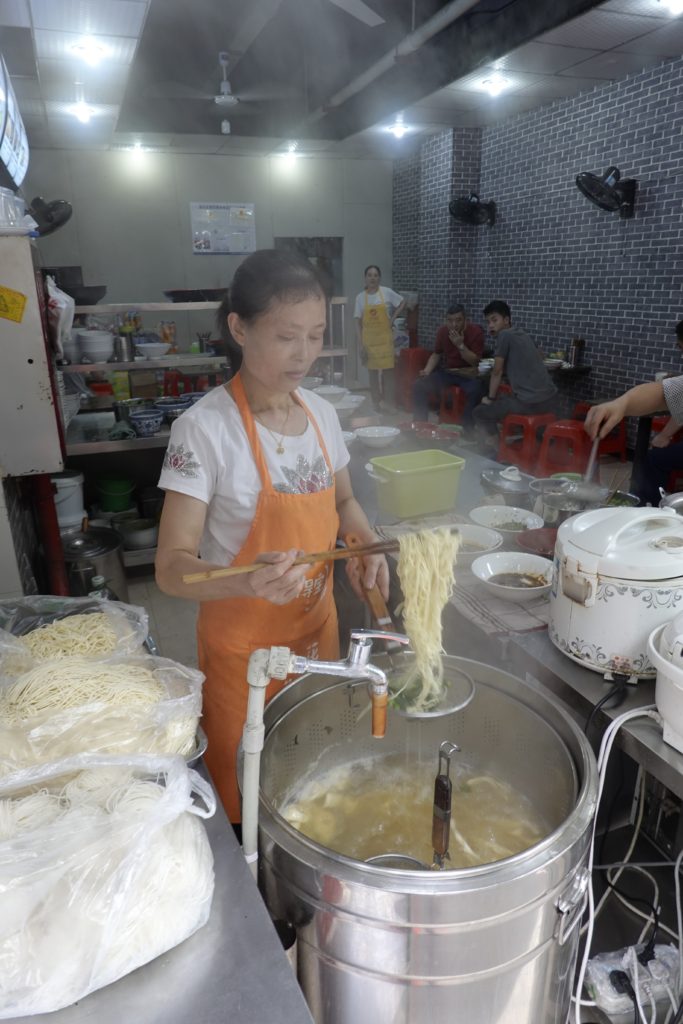
Ma Hongtao, 45, owner of the Laierliang Noodles shop, looked up. “Okay, three
“There are many patrons here,” she said. “I want to remember the respective taste of each one so that by just recognizing them I will know whether they want braised beef broth or clear beef broth, (and) coriander or pepper.”
Remembering each customer’s needs while serving others might seem like a tiresome job. But Ma believes that all the work is worthwhile.
She mixed seasonings in a bowl. When the noodles floated to the top of the water, she transferred them into the bowl on top of the spices. She topped the noodles with juicy chunks of beef and the dish was finished.
Ma makes more than 100 bowls of noodles like this one every day. She stands for hours in a hot kitchen, constantly greeting guests and tidying up the dishes.
“You see, I must frequently use the towel to absorb the sweat on my head. If sweat falls into the pan, the noodles are completely ruined,” said Ma with a smile as she replaced her wet towel with a dry one, and wiped her forehead.
Noodles are an irreplaceable part of life for people in Chongqing. Data from the Ministry of Commerce in Chongqing indicates that 84,000 street noodle shops exist in Chongqing today, and on average, each of them sells 150 bowls of noodles per day. In total, an estimated 12.6 million bowls are consumed by guests in Chongqing every 24 hours.
In the early morning, countless noodle shops are as full as Laierliang Noodles. People even sit on small tables and stools placed outside the shop, and sometimes customers just stand and eat the noodles. It is the thousands of ordinary noodle
Watching those guests, ordinary individuals who are savoring the taste of the delicious noodles in front of them, Ma smiled. In humble occupations that are sometimes disdained by others, workers like Lao and Ma are the best hope for a steady and harmonious society.
— This story was reported and written by students who participated in JEA China‘s 2019 Youth Observation Contest, where it received a superior rating. It has been edited for publication by Global Student Square and is published with permission.

Related Posts