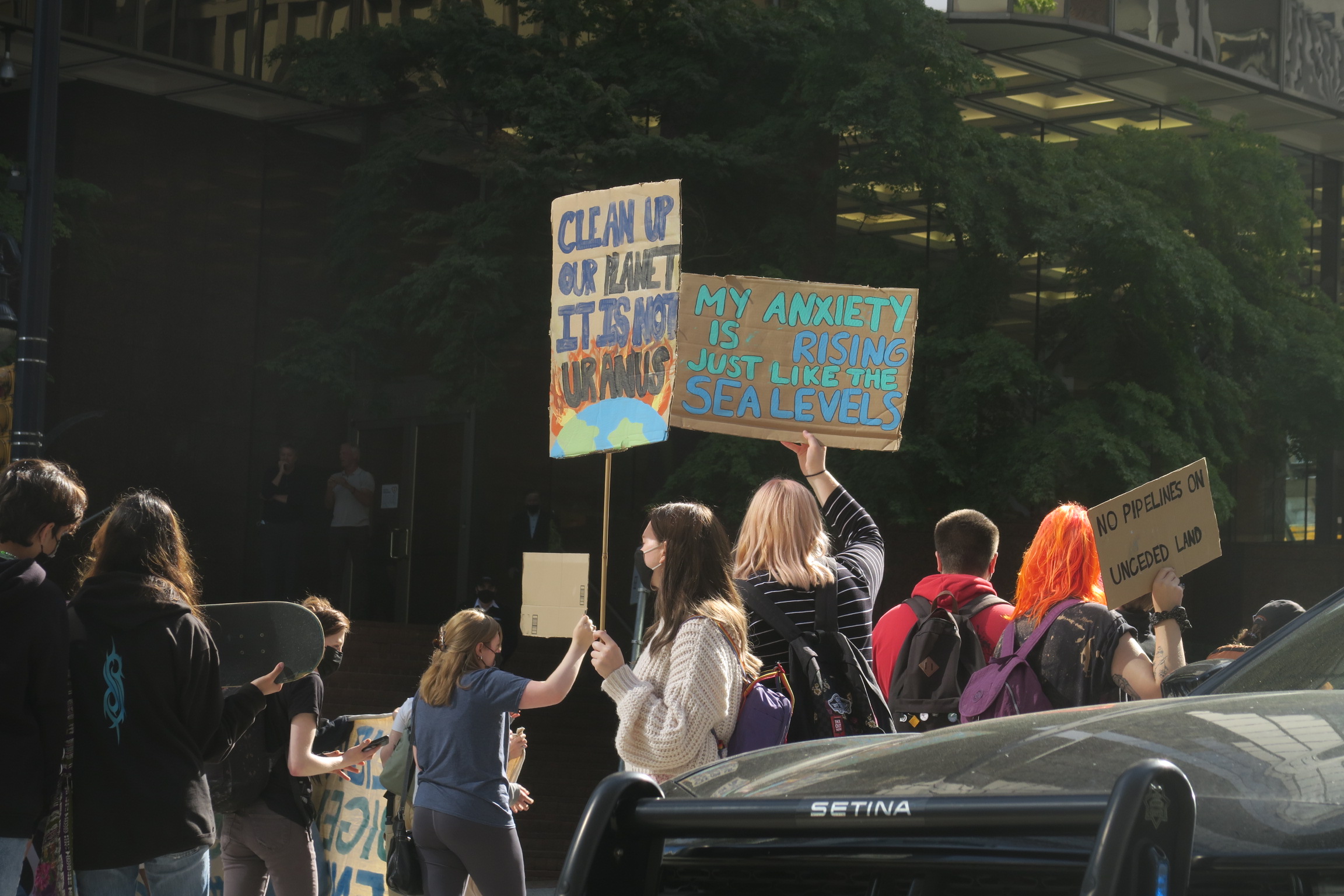
They’re back: Today’s Fridays for Future strike — the first in 18 months — will see youth activists taking to the streets again to push progress on solutions to climate change.
Here’s what you can do to raise awareness and seek solutions where you are.
High school threats on the rise nationwide in wake of Parkland shooting
By Sophie Haber
GSS correspondent
LOS ANGELES — With a slew of “copycat” threats inundating schools, students across the country are feeling the ripple effects of the shooting at Marjory Stoneman Douglas High School in Parkland, Florida.
Since the Feb. 14 massacre that left 17 people dead and dozens more injured, at least 985 schools across the country have received 797 threats, according to The Educator’s School Safety Network. Between Feb. 15. and March 1, U.S. schools averaged more than 70 threats per day. In more than half the threats, guns were found.
A 2015 study published in the journal PLOS ONE said that mass shootings, like suicides and homicides, can cause at-risk individuals to commit similar acts. On average, so-called “contagion” after school shootings lasts for 13 days, according to the study.
“I’ve really noticed the uptick in threats,” said Allie Grayson, a senior at Baltimore City College High School in Baltimore, Maryland. “It was really unsettling to think that people can’t feel safe in their schools anymore and can’t trust their classmates and their peers.”
A student wrote “I’m going to shoot up the school Monday” on a prominent wall at her school, Grayson said, prompting an investigation Feb. 23.
The school notified students that there would be extra school and city police officers on and around campus that Monday, she said. Before entering her school building that morning, Grayson had to walk through a metal detector, and police officers searched her bag.
Students are also taking to social media platforms like Instagram, Snapchat and Facebook when threatening schools — more than half the threats reported by the Educator’s School Safety Network were delivered via social media.
At Beverly Hills High School in Los Angeles, a student who had been expelled wrote “the timing is impeccable” on his Instagram story the day after the Florida shooting. Students and parents contacted the school asking if was safe to attend, and after investigating, the school remained open with a heightened police presence.
However, many students opted not to attend the following day, according to Jenna Kramer, a junior at Beverly Hills. Kramer said that although her classes usually have at least 30 students, her largest class had just 15 students the day after the threat.
“I personally went to school, because I felt like if I didn’t go to school, he would be winning,” Kramer said. “The odds that something would actually happen were slim to none.”
There was extensive security on campus, Kramer said, and students were not allowed to leave classes — even to go to the bathroom — without being escorted, so that during class hours there was never a student walking in the halls.
At nearby Hamilton High School in Los Angeles, students are randomly selected to be searched for guns, following standard practice. Some Hamilton students have started clubs and campaigns against the searches, handing out pins that say “stop random searches.”
Sophomore Abby Ross, however, said they make her feel more safe in the wake of the recent increase in high school threats.
“I, personally, feel as though these searches need to be implemented,” Ross said.
Ross said she thinks students should have to walk through metal detectors before entering schools to protect from future shootings. She is helping to plan her school’s walkout, joining the national student movement advocating for gun control March 14.
“Our generation is one that can impact the future immensely, since our voices are so loud and are not afraid to be heard,” Ross said. “Students, including myself, hope to get some recognition and hopefully some funding for more safety equipment.”
Students at Lakeland High School in Westchester, New York, walked into the girls bathroom to find a threatening message written on the bathroom stall in February, Lakeland junior Jothi Ramaswamy said.
“Everyone’s dead today,” a student wrote, prompting the school to evacuate to a nearby church.
For the next couple of hours, police investigated the threat and police dogs sniffed the campus and students’ materials for bombs, Ramaswarmy said.
“I wasn’t really sure how to feel while everything was occurring,” Ramaswamy said. “On one hand, the bomb threat itself didn’t seem that credible to me as well, but there was still a chance that it was credible and that a student was armed. Once the police said we could go back, I was skeptical of how safe it actually was to resume school, but everything turned out okay.”
Immediately after Lakeland students returned to class, another high school in the area, Walter Panas High School, was evacuated for a similar threat on campus, Ramaswamy said.
The student responsible for the threat at Lakeland, who was expelled from the school, eventually admitted to authorities that she had made the threat to get out of taking a test, Ramaswamy said.
“I think that bomb threats are not taken seriously at all because people just want to do whatever they can to get out of class,” Ramaswamy said. “People do not realize that these threats cause serious public alarm and should not be tolerated.”
After the Las Vegas concert shooting that killed 59 people in October, students in the San Francisco Bay Area saw a similar uptick in school threats, said Annie Lu, a senior at Mills High School in Millbrae, California.
“We’ve seen that every time there is a mass shooting, other potential shooters are inspired to acts of mass violence,” Lu said. “It’s extremely problematic.”
A few days after the shooting in Vegas, a student at Mills High School wrote a threatening message on a bathroom stall, she said. Meanwhile, a school that Lu lives across the street from received a threat that said “I’m gonna shoot up this school tomorrow.” In the two weeks that followed, another school in the county received four bomb threats.
“I remember being hesitant to go to school that entire week and at school, I would always mentally form an escape plan wherever I was in case a shooter came,” Lu said. “I was in shock. I could really feel the tension in my school and everyone was on edge if something was going to happen.”
Lu and Grayson both said that it is important for students to reach out to each other to assuage the effects of bullying in high school, which can often drive a student to make a threat.
Grayson suggested students should call and write to their state legislatures to take a stand against gun violence.
“The difference between the Parkland shooting and previous mass shootings is that the student survivors are standing up and using their voice; we have a lot of traction with their #neveragain campaign,” Lu said. “Young people are the future leaders, so they need to step up and speak out.”
—Sophia Haber is a student at Harvard-Westlake School in Los Angeles.
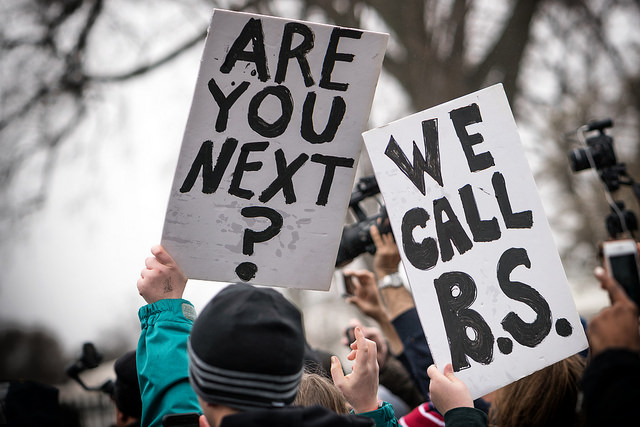
Featured photo: Students hold posters protesting the lack of gun control in the U.S. at a Feb. 20 demonstration organized by Teens For Gun Reform, an organization created by students in the Washington, D.C. area. Photo by Lorie Shaull on Flickr.com/CC BY-SA 2.0.

Related Posts