We consulted with three experts — a family lawyer specializing in divorce, a clinical psychologist, and a stand-up comic — for a different take on the kind of conflict resolution America might need.
Rio residents balance hope, sadness as Brazil battles corruption, violence
By Inès Munchenbach
GSS correspondent
Editor’s note: The past two weeks in Brazil have been especially turbulent, with violence at the annual Carnaval festival, Rio police moving on favelas and Brazil President Michel Temer announcing more military crackdowns may take place in weeks ahead. Correspondent Munchenbach conducted and translated interviews with sources in Brazil for this story. She warns that topics such as gang violence and death may distress some readers.
SAINT CLOUD, France — It has been only a year and a half since the impeachment of Dilma Rousseff, former president of Brazil. Yet Brazilians who hoped for change have seen little to encourage optimism.
Interviews via Skype and video chat with Brazilian citizens and foreigners who live in and near Rio de Janeiro revealed a mixture of hope and sadness as they contemplate whether or not to stay in a country where beauty and luxury live side-by-side with violence and poverty.
“(T)he love of life and the music and the dancing and the partying and samba and Carnaval and all — is that a coping mechanism to deal with issues that surround everybody?” asked Michael Spitz, a math teacher at the American School of Rio de Janeiro.
“Most Brazilians, most citizens of Rio, are afraid,” said Brazilian taxi driver and construction worker Marcílio Antunes Dias. “I don’t even understand why people still come to Rio for tourism.”
To understand the challenges Brazil is facing now, one needs to understand its history of corruption and social inequality.
Brazilian politics have always included corruption, most recently the Lava-Jato (car wash) scandals, in which Judge Sérgio Moro has attempted to prosecute and convict corrupt government officials. Brazil is ranked 38 out of 190 in the World Corruption Index.
Conditions deteriorated rapidly when Luiz Inácio Lula da Silva, known as Lula, was elected president in 2002. After Lula’s second term, Rousseff was elected but was impeached two years into her second term.
And to understand why Rousseff was impeached, it is important to know about the state of Brazil during her presidency. First, the 2014 World Cup and the 2016 Olympics led to mass destruction of favelas, where millions of people live.
In addition, funding for education, hospitals and police fell victim to corruption, reaching the point where precincts in Curitiba and Rio de Janeiro went on strike. Crime levels have risen dramatically both in and out of favelas; being assaulted or mugged at gunpoint is no longer a rarity.
As if this were all not enough, President Michel Temer is now being investigated for bribery and corruption.
But along with corruption, social inequality is part of the story.
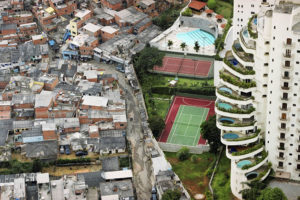
A famous photo — taken in 2004 by the photographer Tuca Vieira in a São Paulo favela called Paraisópolis — demonstrates the proximity in which lower class and upper class live. Favelas are common in Brazil; nearly one in four residents of Rio de Janeiro lives in one.
In 2008, the Rio prefecture sent military police units into favelas to monitor 24 hours a day, seven days a week. This process of “pacificação,” or pacification, proved to be a success — homicides and assault rates dipped both in and out of favelas, as well as drug trafficking, though there were reports of police brutality.
However, because of Rousseff’s and Lula’s corrupt presidencies, the Rio government was driven to bankruptcy, forcing them to remove these police units.
Today Brazil is balanced uneasily between reality and perception. Beautiful beaches have become a haven for criminals. The two weeks of Carnaval, a cornerstone of Brazilian culture that used to be a magical time, are now dangerous, rife with drugs and violence. Nothing is safe anymore — not even schools.
The American School of Rio de Janeiro’s main campus is located in Gávea, almost directly in front of Rocinha. Gang violence forced the school to cancel classes Sept. 21 and Oct. 4 last year.
Both students and teachers say they understand the conflict.
“They’ve been laundering money, they’ve been doing a lot of underhanded deals with each other, and you know, of course, all at the cost of life for Brazilians,” said Gabriel Multedo, an 18-year-old senior at the British School of Rio de Janeiro.
Nadia Sorban, music director at the American School, said that “I never knew what a grenade sounded like, but now (I do), because we heard them go off from school the other day.”
Math teacher Spitz said that “whenever anyone hears fireworks, we get anxious that we’re going to hear a gun battle to follow it up.”
In Spitz’s opinion, such violence is “the accumulation of neglect for the poor segment of society for a good 50 years and letting all of it fester in the favelas.”
Yet instead of improving conditions in the favelas, Temer has chosen to focus on other issues, such as declaring homosexuality a disease. And tensions are rising.
Recently, drug gang Comando Vermelho (Red Command) and neighboring gang Jacarézinho (Little Alligator) began a turf war in Rocinha, the largest favela in the city of Rio de Janeiro. An elite military police unit, named the Batalhão de Operações Policiais Especiais (BOPE), has planned a major operation across the entire city to attempt to eradicate the inter-gang drug violence.
But Rio residents don’t expect much to improve.
“(Corruption) seems to be too pervasive and too ingrained, and it doesn’t seem like there’s a way for this to be solved,” Spitz said.
Dias believes that “in the short term, nothing will really change.
“Only when the government creates a new penal code, a new constitution, and replaces every government official, will things begin to change,” said Dias. “The problems are a lot more integrated into the fundamentals of our country that we believe them to be.” Many Brazilians consider the constitution to be filled with loopholes, while the penal code prevents any punishment for any perpetrator under the age of 18, a rule that ironically promotes the employment of children by drug gangs.
The quality of life in Brazil “needs to improve,” said Sorban, “but I’m not sure that it’s going to.”
That leaves Brazilians with little choice but to wait. When protests and petitions fail, for some there is no alternative but crime, while others try to carry on with life as usual.
“Nobody knows what will happen,” said Dias. “Nothing is working and everything has stopped. People who used to go to bars, parks, they don’t go anymore. People get assaulted day, night, all the time.”
Some of those with the means to leave have decided to do so. As of last November, Sorban was waiting for her work contract to expire so she could return to the United States or Europe.
“I will be leaving soon,” Sorban predicted. “And I do think that a lot of people are going to leave before their time could have ended.
“I know lots of Brazilians who are leaving, and that doesn’t feel encouraging when the Brazilians want to go to Canada and I’m still here,” Sorban said.
Munchenbach is a student at the American School of Paris. Reporting assistance by Lívia Andrade Clemente/American School of Paris
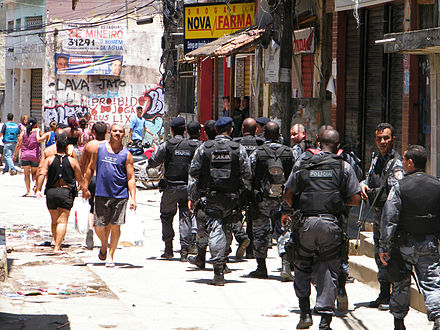
—Featured photo: Military police enter the Alemão favela during a military operation in Rio de Janeiro in 2010. Wikimedia Commons photo.

Related Posts