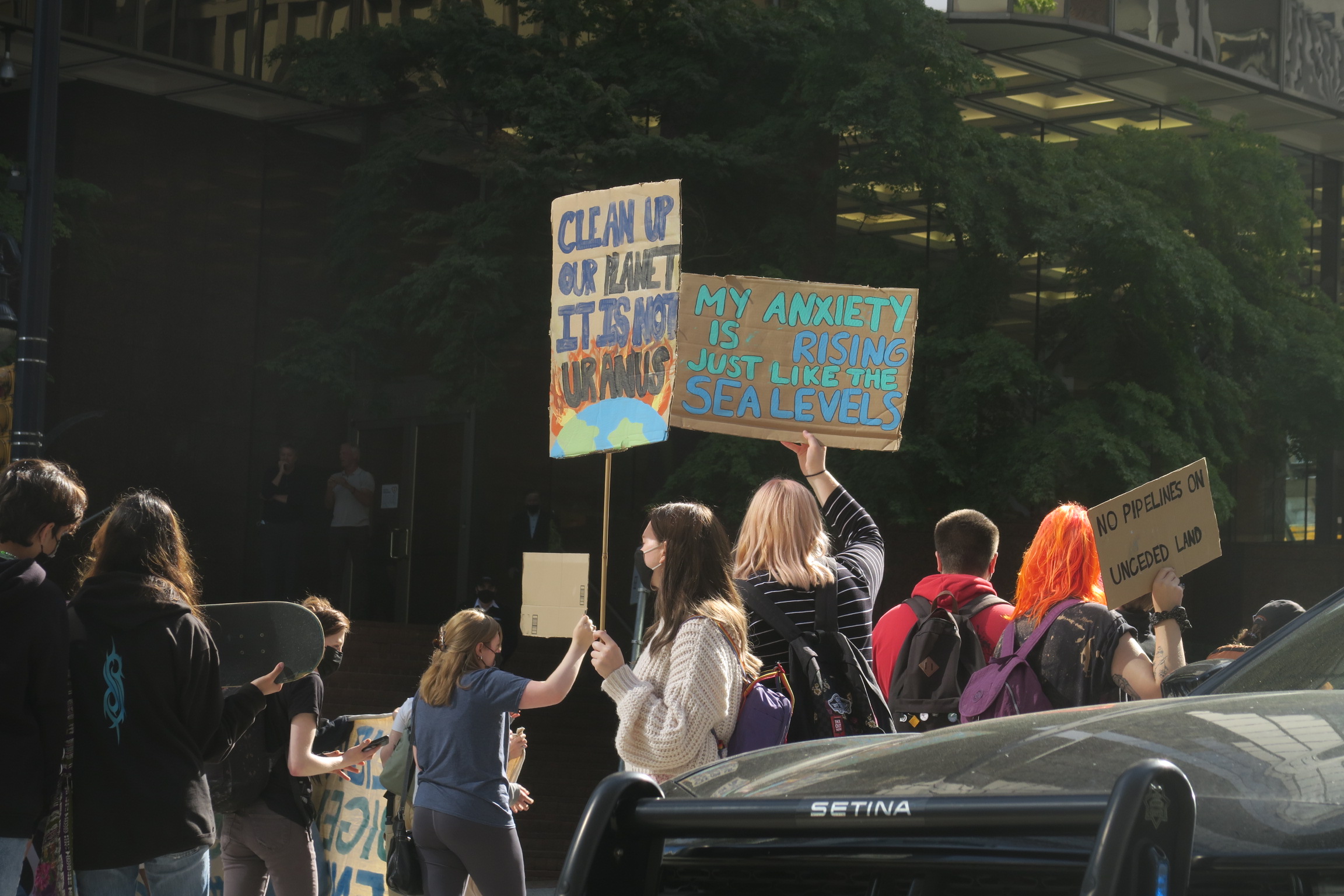
They’re back: Today’s Fridays for Future strike — the first in 18 months — will see youth activists taking to the streets again to push progress on solutions to climate change.
Here’s what you can do to raise awareness and seek solutions where you are.
Liter of Light: Ending energy poverty, one bottle at a time
By Bethany Ao, GSS correspondent
PARIS — It’s like the old joke: How many people does it take to screw in a lightbulb? Or bring energy and light to places where there is none?
A nonprofit group called Liter of Light is offering an innovative answer to that question.
During a workshop at today’s COY11 climate change event in Paris, a small group of people huddled around a small wooden table covered with wires in a corner of the Parc de Expositions. Each was juggling a set of instructions and materials, including screwdrivers.
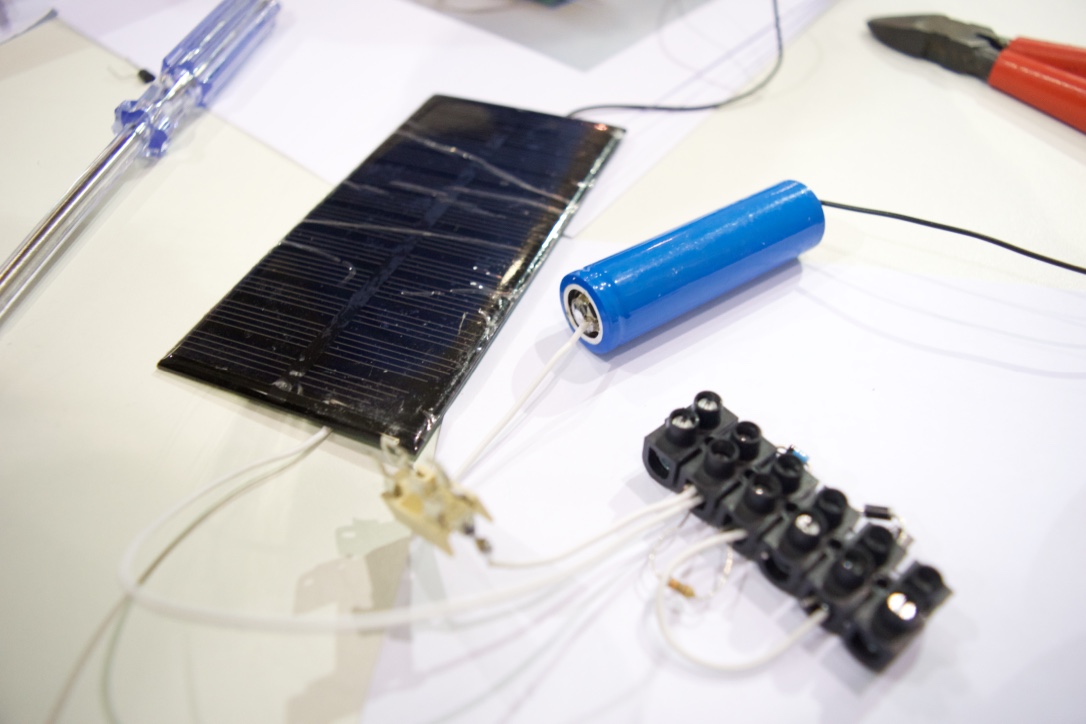
Their goal? To convert a plastic water bottle into a surprisingly bright lightbulb with the aid of a solar panel and a battery box.
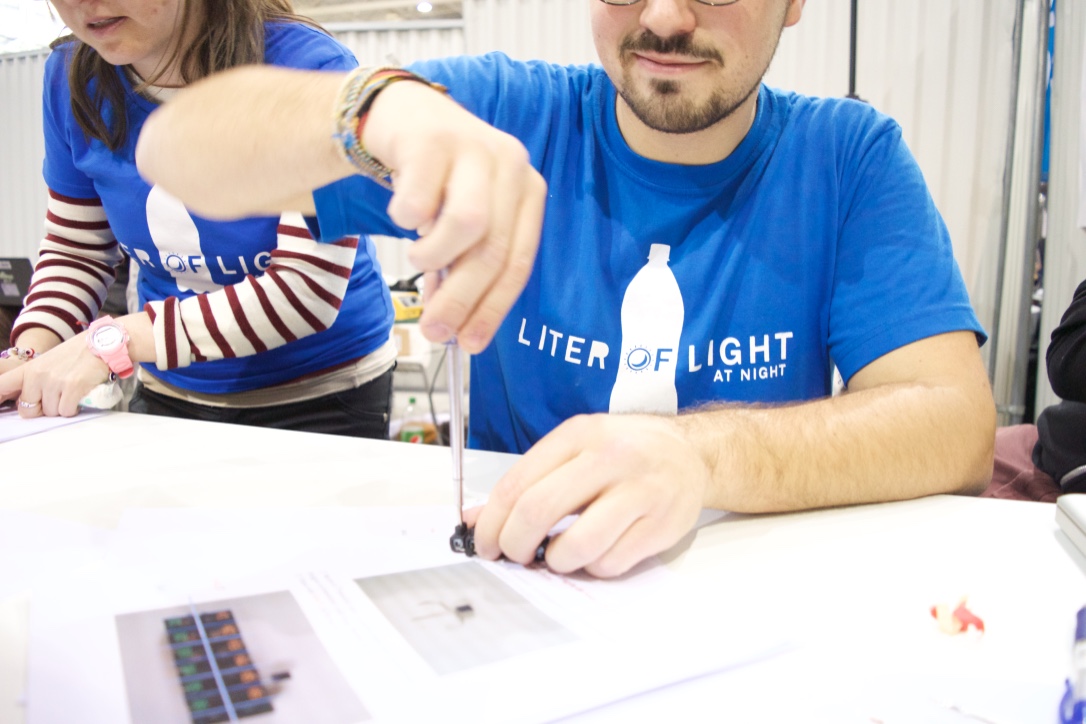
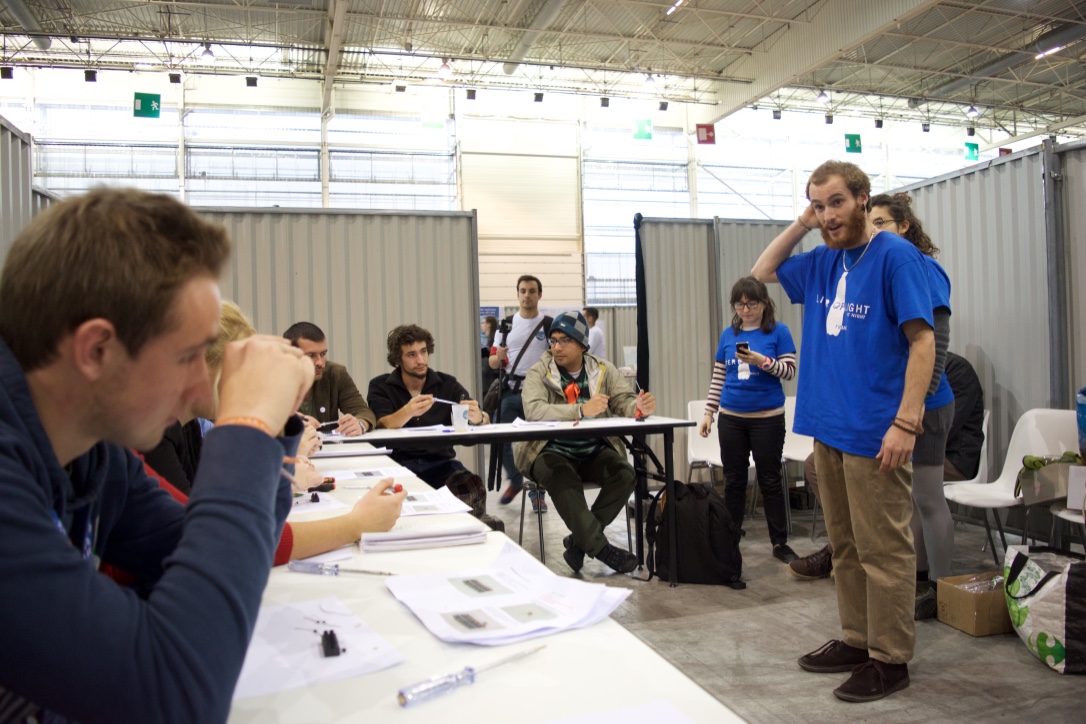
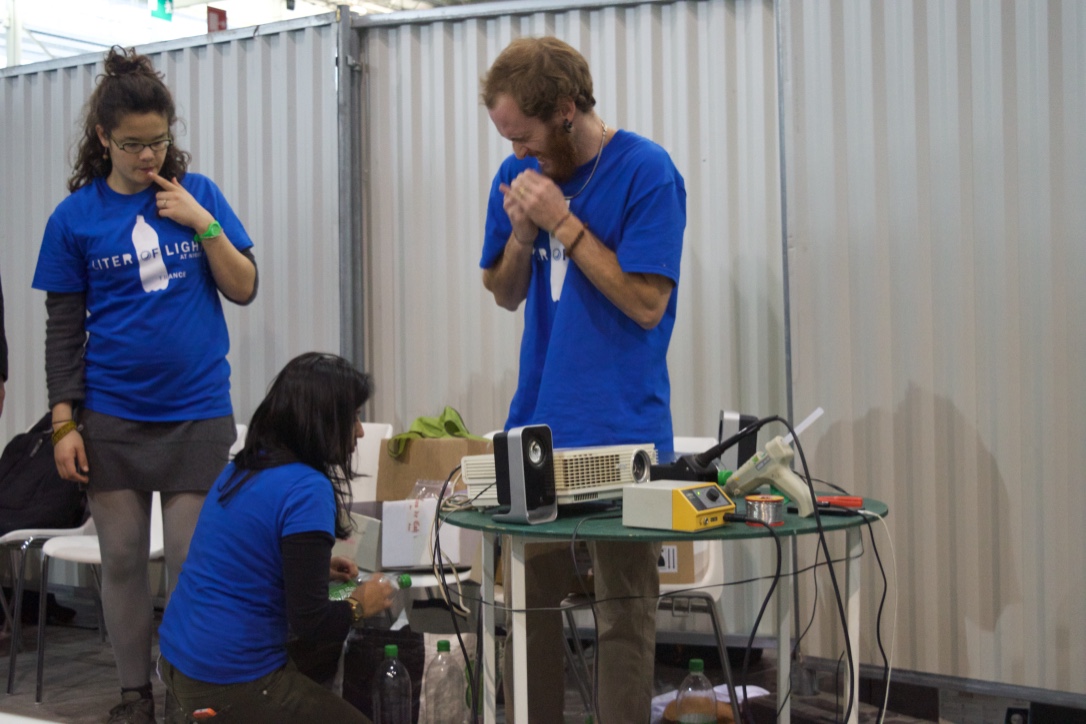
“I liked it, I learned something new,” said workshop participant Rocio Olivares of Spain.
“I know now how to make light out of something like this (circuit). It’s not so easy, but it’s not that difficult either.”
Liter of Light is a project of MyShelter Foundation, a Philippines-based nonprofit organization whose mission is to take sustainable building practices to a grassroots level.
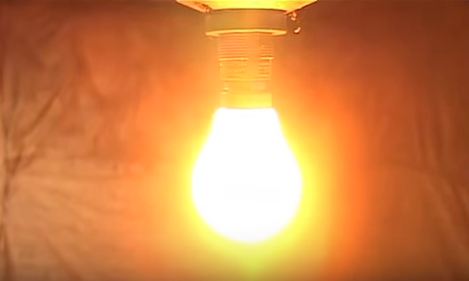
Here’s how Liter of Light works: A one-liter bottle, filled with water and chlorine, is fitted to a 55-watt lightbulb using a solar panel, which is charged by a battery that can be switched on at night.
Liter of Light got its start after Typhoon Haiyan (Yolanda) hit the Philippines in 2013, destroying thousands of homes and displacing millions of residents.
“Thousands of lights had been broken and 40 million houses had been destroyed, or just the roofs had been flipped out by the wind,” said Giacomo Battaini, vice-director of Liter of Light in Italy. People “couldn’t see what was left, and also they couldn’t work by night to try and rebuild their own houses or to find their families.”
Under such conditions, there was a huge need for a cheap and adaptable lighting system that could be installed in disaster areas and could work off the grid, Battaini said.
 Liter of Light now works with community groups around the world to teach people how to make and install the lights.
“We focus our attention on teaching women and involving children too,” said Battaini, noting that children are often better at constructing the liter bulbs than adults.
“We train the people to build their own light from recycled materials, which is the most important part,” Battaini said. “We get them to save their own bottles, from the ground, from the waste.”
In some parts of the world, “recycling is not even known as a word. There’s no way for them to recycle a plastic bottle,” Battaini noted.
“We teach the people not only how to build their own light, but we also give them the possibility of being self-dependent, to fight energy poverty, and to let the people know the good properties related to renewable energy.”
Liter of Light organizers are working intensively with the Philippine delegation at COY11 to engage them in upcoming climate change negotiations and to show that a local group from the Philippines can have a global impact.
For the upcoming COP21 climate change summit beginning next Monday, MyShelter has pledged to light five islands in the Philippines and five countries around the world within 80 days, in an attempt to empower what the UN calls “the southern world” and to demonstrate that renewable energy tools can be available to all.
The concept behind Liter of Light came from Alfredo Moser, a Brazilian mechanic who came up with the idea to use plastic bottles to refract sunlight during one of the frequent electrical blackouts that afflict his city of Urebaba, in southern Brazil.
Moser’s idea caught fire in the Philippines, where one in four people lives below the poverty line and electricity is expensive. MyShelter specializes in using sustainable and recycled materials such as bamboo, tires and paper, so using recyclable plastic was a logical next step.
Over the past four years, Liter of Light has spread to 28,000 homes and 70,000 people in 15 countries, including India, Indonesia and even Switzerland. Liter of Light estimates that there are 350,000 liters lighting up in homes, shops, schools, medical centers and villages worldwide.
Cheap, common and confoundingly present despite efforts to contain them in recycling programs, plastic bottles contribute not only to landfills but to ocean pollution. According to the U.S. National Resources Defense Council, 80 percent of all marine litter “originates on land, and most of that is plastic.”
Liter of Light is getting a boost from the U.S. beverage manufacturer Pepsi, which is offering to give LOL $1 for every use of the hashtag #PepsiChallenge on a personal Twitter. Pepsi has pledged to raise up to $1 million for the liter program, which costs $1.50 per bottle to install:
What Can You Buy for a #Dollar? https://t.co/BOpRN6xrDD @Pepsi donates a dollar every time u use #PepsiChallenge pic.twitter.com/5YiTEGAHuH
— Liter of Light (@literoflight) November 25, 2015
 —Photos by Bethany Ao. Ao is GSS News Editor for Europe and a junior at Northwestern University’s Medill School of Journalism. See more of her on-the-ground reports from COY11 on Twitter @GSSVoices, #GSS_COY11 and on Facebook. Follow Ao @BethanyAo and email her atbethanyao2017@u.northwestern.edu.

Related Posts