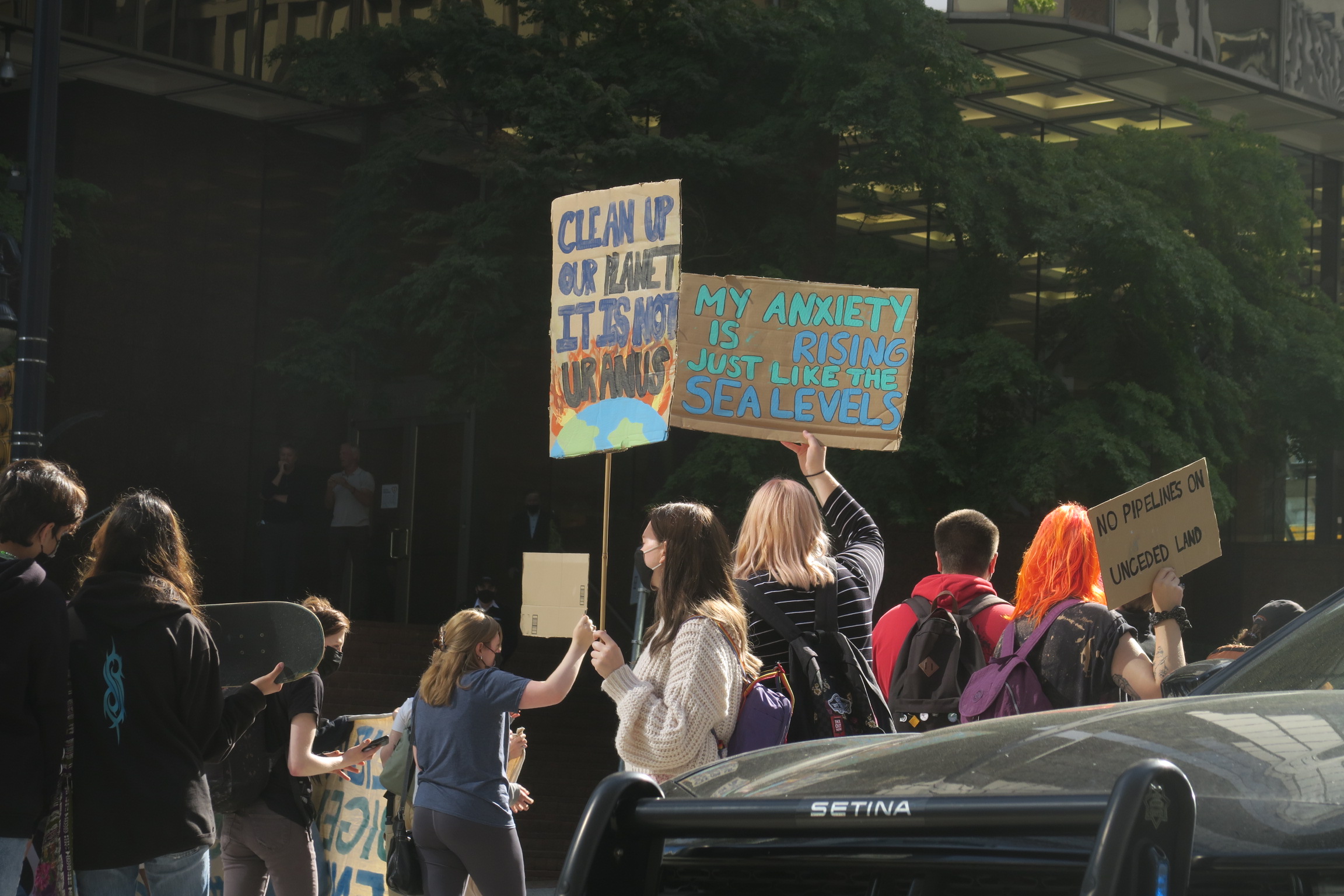
They’re back: Today’s Fridays for Future strike — the first in 18 months — will see youth activists taking to the streets again to push progress on solutions to climate change.
Here’s what you can do to raise awareness and seek solutions where you are.

Explainer: Ukraine, an ethnic, geographic and cultural quarrel that just won’t end
The devastation of Kiev’s Maidan Square, where protesters demonstrated against new laws passed by the Ukrainian parliament in 2014 limiting freedom of speech and assembly, and pushed for greater ties between the Ukraine and Russia, is a stark reminder of the tensions that have simmered between the two countries for hundreds of years. This explainer by Sequoia High School students takes a look at the history, the ethnicities, the geography, and the reasons why the latest Ukraine-Russia conflict may not be the last. —the editors

Background Information
Maidan Square: A famous square located in Kiev, the capital of Ukraine, it has been the site of many political protests throughout Ukraine’s history. A meeting place in the Ukraine’s darkest days, its name has changed with the passing of Czarist, Soviet, and independent regimes. Analogous to Cairo’s Tahrir Square, Maidan Square is the place where, in times of struggle and unrest, the people of Ukraine have gone to vocalize their anger. While it is a political space, it is also in the middle of the city and a hub for the metro, a transit crossroads as well as a protest zone.
Why is this important?
Thousands of Ukrainians went out to protest after former President Yanukovych strengthened ties with Russia and rejected a trade accord with the European Union. Many citizens had been hoping for a move towards European values and away towards political corruption. However, protests became heated after the police brutally separated the protesters.
The conflicting opinions between East and West could be further amplified if the protests continue and as Western diplomats continue to show support for the protesters. Still, Ukraine has not been offered a place within the European Union. The West has not taken a definitive step towards figuring out the future of Ukraine, though there has been much concern over violence. Even so, it would be economically beneficial to Western Europe to keep Ukraine out of Russia’s political grip, especially since there are key gas pipelines running through the Ukraine.
An ethnic divide
Ukraine is divided into two major ethnic areas: the east and the west. In the east (see map below), the majority of the population speaks Russian; these people associate themselves with Russia and identify primarily as Russians. In the west are Ukrainian-born citizens who identify with their country of birth. This has created longstanding tensions. The line that divides the country exists a few miles east of Kiev, the capital. The Putin government has justified its military move into eastern Ukraine by saying that it must defend the Russian-speaking majority there.

A potential buffer state
Ukraine is situated just to the west of Russia. If it was a part of Russia, it would act as a buffer between Russia and the rest of eastern Europe.
The bottom line
It’s not hard to see why Russia would want to renew its hold over the Ukraine, especially given Putin’s regime, which is reminiscent of Soviet times. Russia feels a moral obligation to free Russian-speaking people and bring them home to their mother country. However, such moral feelings aside, invading another country is a sign of war, which is viewed with alarm by the United Nations. Ever since World War II, the world has had a widespread fear of war. Appeasement is one alternative, in which countries give into an aggressor’s terms. The United Nations has not sent troops into the conflict. Ukraine must deal with Russia alone.

Related Posts