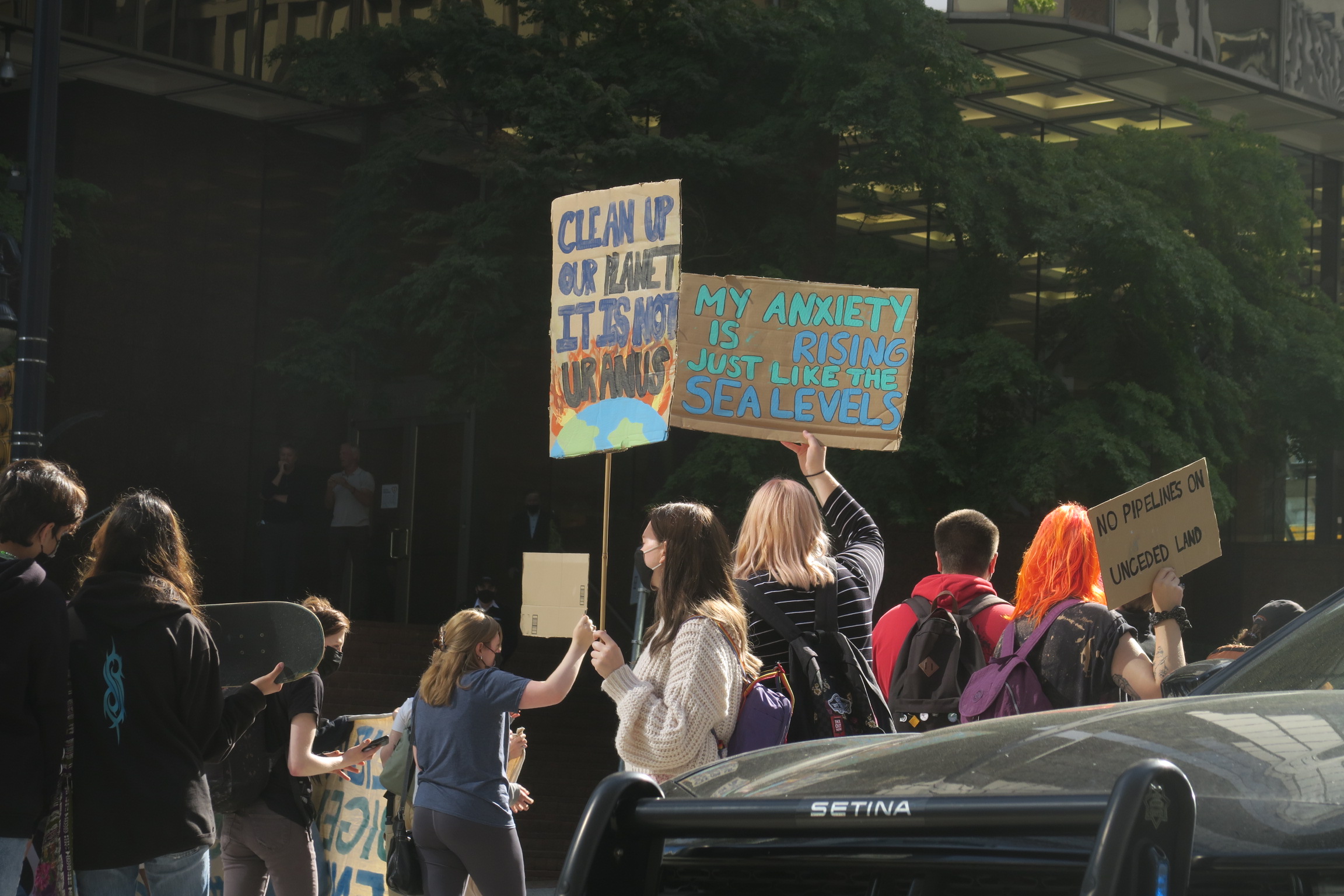
They’re back: Today’s Fridays for Future strike — the first in 18 months — will see youth activists taking to the streets again to push progress on solutions to climate change.
Here’s what you can do to raise awareness and seek solutions where you are.

Recent string of celebrity suicides puts spotlight on mental health in Japan
By Erika Hornmark
Newsroom By the Bay Now

HONG KONG — At a time when the world is suffering from a pandemic, there is a very different but similarly tragic death toll taking place in Japan, one that is striking young people in the prime of their lives and in ways that challenge easy explanations.
Since mid-May, the suicides of some of the biggest names in Japan’s entertainment scene, such as Yuko Takeuchi, Hana Kimura, Sei Ashina, and Haruma Miura, have sparked discussions on suicide prevention and the accessibility of mental healthcare in Japanese society.
Yuko Takeuchi was a 40-year-old actress known for her appearance in television series such as “Miss Sherlock,” “Asuka” and “Lunch no Joo” (The Queen of Lunch). Hana Kimura was a successful wrestler and actress known for her work on “Terrace House” when she died at the age of 22. The lead of the film “Silk” and television show “Kamen Rider Hibiki,” Sei Ashina died in September at the age of 26. Haruma Miura, a film actor and singer popularized for his work on “Attack on Titan” and “Gokusen,” died at age 30.
Japan, a country that has historically had difficulty with public discussions about suicide, has seen an uptick in suicide cases in the past few months. Disruptions due to the pandemic, such as shuttered theaters and cancelled performances, have taken a particularly heavy toll on the entertainment industry, creating anxiety among artists.
Significantly, suicides among prominent artists along with the undercurrent of unaddressed pandemic-related mental health needs are coming together during a time in which young students and teens who love and support these artists also are particularly vulnerable.
Empty stages leave entertainers in the dark
Restrictions on large gatherings have put considerable strain on companies and social spaces, prompting many in Japan to move their work — and lives — online.
The entertainment sector has been hit especially hard, as actors, actresses, models, musicians and other entertainers have been barred from performing in large group settings following several super-spreader incidents in theatres and studios.
One such incident occurred in July at a 190-seat theatre in Shinjuku District, Tokyo, where an estimated 800 spectators may have been exposed to the coronavirus. Recording studios and film sets have likewise been flagged as potential hubs for contamination, due to the close proximity of workers and lack of mask-wearing. And though some parts of the entertainment industry report trudging on through the pandemic, those who are still working report feeling anxious about the conditions to which they return.
For many independent freelance artists, restrictions on exhibitions and concerts may have caused a sudden halt in income and social interaction. Similarly, artists who work in digital spaces are often more prone to cyberbullying and trolling on social media, which, in addition to economic stressors, loneliness and isolation, can culminate in an overall decline in mental health.
While the pandemic has sparked a noticeable increase in Japan’s average social media usage, it has also seen celebrities such as Hana Kimura on the receiving end of increasingly-high levels of cyberbullying. Many of the entertainers were forced to postpone events, film and music releases and other projects, resulting in unhappy fans and emotional stress all around.
Like many others in COVID times, celebrities, who are often surrounded by others, likely have experienced a rapid drop in social interaction, and may have felt a lack of support as a result of the circumstances. In Japan, where those struggling with their mental health can struggle to access help, it’s likely that they didn’t have many outlets to turn to discuss their struggles.
A 2019 report from the Organization for Economic Cooperation and Development says that the suicide rate per 100,000 persons in Japan been on a steady decline since 2009, but remains higher than most nations in the OECD:
Understanding Japan’s long-standing struggle with mental health and suicide
Japan’s suicide rate has long been a topic of discussion. According to the OECD, the country was reported to be among the 10 highest suicide rates worldwide between 2015 and 2018. According to reports compiled by Japan’s National Police Agency, as of the end of October, Japan had tallied more than 17,200 deaths by suicide, compared with 1,983 caused by COVID-19 related illnesses in 2020.
There has been a strong historical correlation between the financial climate and the rate of suicide in Japan.
According to a January report in the Japan Times, Japan saw a surge in suicides in 1998 “when unemployment linked to the bankruptcies of corporate behemoths such as securities firm Yamaichi Securities Co. and the Hokkaido Takushoku Bank led to many middle-aged men taking their lives.”
A 2009 study published on ScienceDirect, a peer-reviewed journal, observed that the 1997-1998 stock market crash in Japan suggested a correlation between the financial crisis including an increase in unemployment and a rise in Japan’s suicide mortalities. According to a report by the Associated Press published by the Deseret News, at the height of the stock market crash in 1998, Japan’s total suicide rate increased by 34.7% compared with 1997.
As reported by the Japan Times, suicide cases peaked at 34,427 in 2003, prompting the Japanese Diet to pass the Japanese Basic Act for Suicide Prevention into law in 2006. The act funded suicide prevention programs, provided emotional counseling to the relatives of those who died by suicide, and advocated for mental health initiatives. According to the World Health Organization, the act appears to have been successful, prompting a continuous decrease in overall suicides in Japan in the early 2010s.
But coronavirus poses a new challenge. Thanks to a pandemic-induced economic slowdown, Kyodo News reported in October that unemployment in August reached its highest levels in three years. Experts warned in September about a troublesome increase in suicides among “working men,” now without workplaces and jobs.

Teens and adolescents cope with loss of idols, everyday life
However, it’s not only Japan’s working men struggling with suicide. Japan’s women and children are another concern, with a reported 40 percent increase in women committing suicide in August and the number of suicides among students in elementary to high school reaching 59, more than double the previous August.
Unfortunately, this pattern is not new, with suicides being the leading cause of death for Japanese students aged 15-19 in 2018. Since 2019, for the first time during the postwar period, suicides have become the leading cause of death for Japanese students aged 10 to 14 years of age.
Discussion around these high-profile suicides have only renewed students’ concerns regarding mental health across Japan and within their communities.
Mina, a high school junior in Saitama who asked that her last name not be used, reported that Hana Kimura and Haruma Miura’s suicides were widely spoken about in her school in Tokyo. Mina, a fan of the television show “Terrace House” and the film “Never Let Me Go,” was saddened by the suicides; she believes the incidents were most likely driven by stress and the constant cyberbullying that celebrities face online.

Traditionally, Japan’s students have struggled with mental health. Many have attributed the prevalence of youth suicides to academic pressures and bullying. A report by Japanese Ministry of Education, Culture, Sports, Science and Technology tracking over 40 years of data noted that Japanese students are most likely to attempt suicides on the last day of summer break before school resumes. This year, some suspect that the shift from distance learning back to in-person schooling has further exacerbated pressures, such as to catch up on work and return to a high-stress environment.
According to Tokyo high-school sophomore Kao Umeno, although anti-bullying campaigns are commonplace at her school, there is no curriculum or class placing emphasis on student mental well-being. Similar accounts were voiced by Miri Yamamoto, a high school student attending a private school in Tokyo, who says that although her school does have counselors, counselors often don’t bring up mental health unless asked and school assemblies do not address the issue either.
Japan, which has historically struggled with discussing mental health issues, was — and perhaps still is -— began making headway in suicide prevention efforts starting in early 2000’s. Yet the pandemic presents a new and serious challenge that is likely to persist well into the new year.
“Covid-19 makes it hard for schools to reach out,” Mina wrote in an email. “Japanese students are more likely than others to commit suicide, so lack of support from schools could be catastrophic. Now (there is) less school support than before — which … was very little.”
—For those in the United States, if you or someone else is struggling emotionally, please reach out to the National Suicide Prevention Lifeline, 1-800-273-8255 or the SAMHSA (Substance Abuse and Mental Health Services Administration)’s National Helpline, 1-800-662-HELP (4357). If you or someone else in Japan is struggling emotionally, please reach out to Japan’s Yorisoi Hotline, 0120-279-338 or TELL Lifeline (not Toll-Free but English-Speaking), 03-5774-0992.

Related Posts